


From the very early days of TNF, I’ve been banging a consistent drum: your fatherhood experience will be shaped by the books you read, the things you watch, the people you spend your time with and the habits you build. We started a TNF Book & Movie Club to offer a space for dads to come together and discuss some of the interesting places where modern media and parenting intersect.
Another Round, released in 2020, is one of the most arresting explorations of fatherhood committed to screen. I’ve seen in three times since it’s release, and got something different out of it every time. In anticipation of next week’s inaugural TNF Movie Club I wanted to share this pretty much SPOILER FREE essay on the film, some of the ways it has intersected with my own fatherhood experience, and why you should watch it (even if you’re not planning on joining us to talk about it.)
Stop me if you’ve heard this one before: “Fatherhood changes you.”
It’s how every essay here could start. You know the story well. But there’s a breadth and depth of transformations that run from the obvious (and wonderful) “you’ve never known love like this before” to the deep, darker, more existential ones we’re less comfortable talking about. A lot of ink has been spilled on the loss of identity that a mother can face after the birth of a child—in the New York Times, the Washington Post, and Harvard Business Review, to link a few. “Anything written on the topic from the perspective of the dad?” you might be asking. Sadly, you know this story too.
“When Rachel returned to work after maternity leave, she felt like she was floating, distracted. She couldn’t perform to her own standards at the office and felt like she was dropping the ball at home, too. She had built her identity around her competence and intelligence. Now that all seemed to belong to someone else.”
— Janna Koretz, “New Mothers, Let’s Talk About Your Professional Identity Crisis”
Feel like you’ve lived that paragraph yourself? I’m sure I’m not the only one. I moved to a new country, where I couldn’t speak the language, working for myself for the first time, with a new baby, all in the space of a year. “Loss of self” becomes an all-encompassing black hole when you’re living through it.
Another Round—directed by Dogme 95 auteur Thomas Vinterberg and starring occasional Bond villain, ballet dancer and Hideo Kojima man-crush Mads Mikkelsen—explores the existential dread of a man searching for himself and grappling to understand what happened to his life: married to a woman he sees fleetingly, two kids fully grown and imminently leaving home, and stuck in a job he hates with students who share the sentiment.
“Have I become boring?” Mikkelsen asks his wife. She can only offer him a passing condolence: “You’re not the Martin I met.” At a 40th birthday party his friends tell him he lacks joy. He had so much potential—on track for PhD tenure, the trajectory undeniable—then had children, and his life took a different turn. Whilst these four middle-class teachers share the joys of a glass (or four) of wine, one shares a plausible theory that humans are born with a blood alcohol level 0.5% too low. If only they could stay constantly topped up (to the order of a glass of wine of two) everything would work better: a more productive, more enjoyable, constant state of intoxication.
“I looked at world history and how many huge accomplishments and world-changing decisions have been made by drunk people. I thought that was interesting, because it contrasts with the very chaste conversation that we have about alcohol normally. But as I dug into it, I realized that it was even more interesting — this thing that could elevate conversations and change world history can also kill people and destroy families. And still it’s widely socially accepted and has been here for thousands of years.”
— Thomas Vinterberg
And so the experiment begins: a legitimate scientific approach, recorded dutifully. Characters explore their own relationships with alcohol, breathalyzing constantly through the workday to stay above the acceptable limit. They regale each other with the tales of great historical minds who used alcohol as a lubricant for creativity—Hemingway who drank everyday until 8pm, only stopping so he was sober enough to carry on drinking the next day; Churchill who is cited as a figurehead of merit whilst also being a lush. They rediscover joy in their life through their study—becoming better teachers, better partners, better parents. Mikkelsen is phenomenal in the role, the transformation painted across his face: more playful with his oratory in the classroom, happier at home with his kids, finding joy in all of the little moments. A more ideal version of himself everywhere.
Søren Kierkegaard should be credited as a co-writer on the film, so central is his work to the themes presented. The characters quote him repeatedly, including a scene where understanding one of his essays becomes a literal test to be overcome. “With having failed,” a student says, “you must accept yourself as fallible in order to love others and life.” In another class, another teen quotes the Danish thinker: “To dare is to lose one's footing momentarily. Not to dare is to lose oneself.”
These characters dare. And they do not lose themselves. Quite the opposite. But there is collateral damage along the way: lost jobs, lost partners, lost friends, the occasional lost connection to reality. What transpires is that it isn’t the alcohol that helps these characters find who they are. It’s the daring of an experiment, taken together. There are many times when normality tries to call them back, a siren attracting them back to nothingness, deftly avoided.
The film doesn’t sugarcoat the dangers of alcohol misuse, as various characters find an alcohol-induced nadir during the film. And it’s important not to downplayed these dangers—whilst writing this essay the NYT shared research showing a 25% increase in alcohol related deaths in 2020, primarily attributable to an onset of pandemic drinking. Characters hide their habits, some more successfully than others. But the film takes strides not to demonise those who find a more open, less overwhelmed version of themselves arriving after a drink or two. This film left me feeling less guilty about the occasional lunchtime beer, and a lot clearer on exactly what I was getting out of that drink. It’s a provocative take on the role that alcohol plays in our lives, and an opportunity for introspection with which you can absolutely substitute booze for all manner of vices and the core themes will still ring true. On my most recent viewing I saw it as a clear allegory for microdosing—a small amount of a substance that you take every day, or every few days, that allows you to be closer to your ideal version of self than possible before.
The director’s daughter, who inspired him to make the film and was due to star in it, was tragically killed in a car accident four days into filming. Vinterberg’s immediate response was to make the film more life-affirming: “Having just lost a life, the celebratory element became extremely important.” The film ends in a scene of pure, unbridled joy: an ode to living in the moment, as Martin’s holds his past (and potentially future) in his hand, full of possibility, but with a current day demanding to be seized. Right here, right now.
On each viewing of this film I’ve felt it conversing with a different part of my fatherhood experience, another perspective waiting to be explored. I don’t feel skilled enough to articulate some of these issues as vividly as Vinterberg does. But that’s the wonder of cinema. That’s why we watch these films.
“Martin is a man standing on the platform and the train has left him. A man who is slowly but surely cracking up. He's just sitting there feeling pity about himself and it dawns on him that he has wasted his life—that's at least what he thinks. Throughout this experiment, he realizes that it's not something that he has to regret in his past. He loves his wife, he loves his family, and he used to love his job. It's just about seeing everything again, recharging his eyes and falling in love with the present again."
— Mads Mikkelsen
OK. It’s almost 6pm here. Friday evening calls. Time for a beer.
The New Fatherhood “Weekly Summits”
We’ve been beta-testing a weekly meeting for community members, which we’re calling “summits” (thanks to Carlos for coming up with the name, which invokes the appropriate delusions of grandeur whilst ensuring it doesn't ever feel like work.)
We’ve got the next two months scheduled, including next week’s discussion of Another Round, a talk about psychedelics and parenting, a career check-in, another book club on which we haven’t settled on a title yet (I’ll most probably punt the shortlist to a vote in the community) and many more.
I’ve also been working on a way to surface these events outside of the app, so supporters of TNF can get involved more easily without needing to use the app. Simply click any of these links to sign up:
TNF Movie Club #1 "Another Round"
Tuesday 29th March, 10am EST / 3pm GMT / 4pm CEST
Let’s get together and talk about this excellent movie.
Monthly Hello 👋
Tuesday 5th April Feb, 10am EST / 3pm GMT / 4pm CEST
Low-key, low agenda chance to talk about al things fatherhood. A good time to pop your head in and say hello.
Psychedelic Parenting
Wednesday 12th April, 10am EST / 3pm GMT / 4pm CEST
An open, honest, and very private conversation on drugs and parenting. Come along to learn more or to share your own perspective.
“How Are You?” well-being check-in
Wednesday 19th April, 10am EST / 3pm GMT / 4pm CEST
A chance for us to talk about stress, mental health, and wellness.
Lots more “summits” on the new events page. Let me know if you’d like to attend any of these things and the timezones don’t quite work. Last month we had a dad dial in from New Zealand at 4am, doing a night-time “get back to sleep little baby” stroll. Joel—we salute you. Hope the little one got back to sleep OK!
Finally: about The New Fatherhood App …
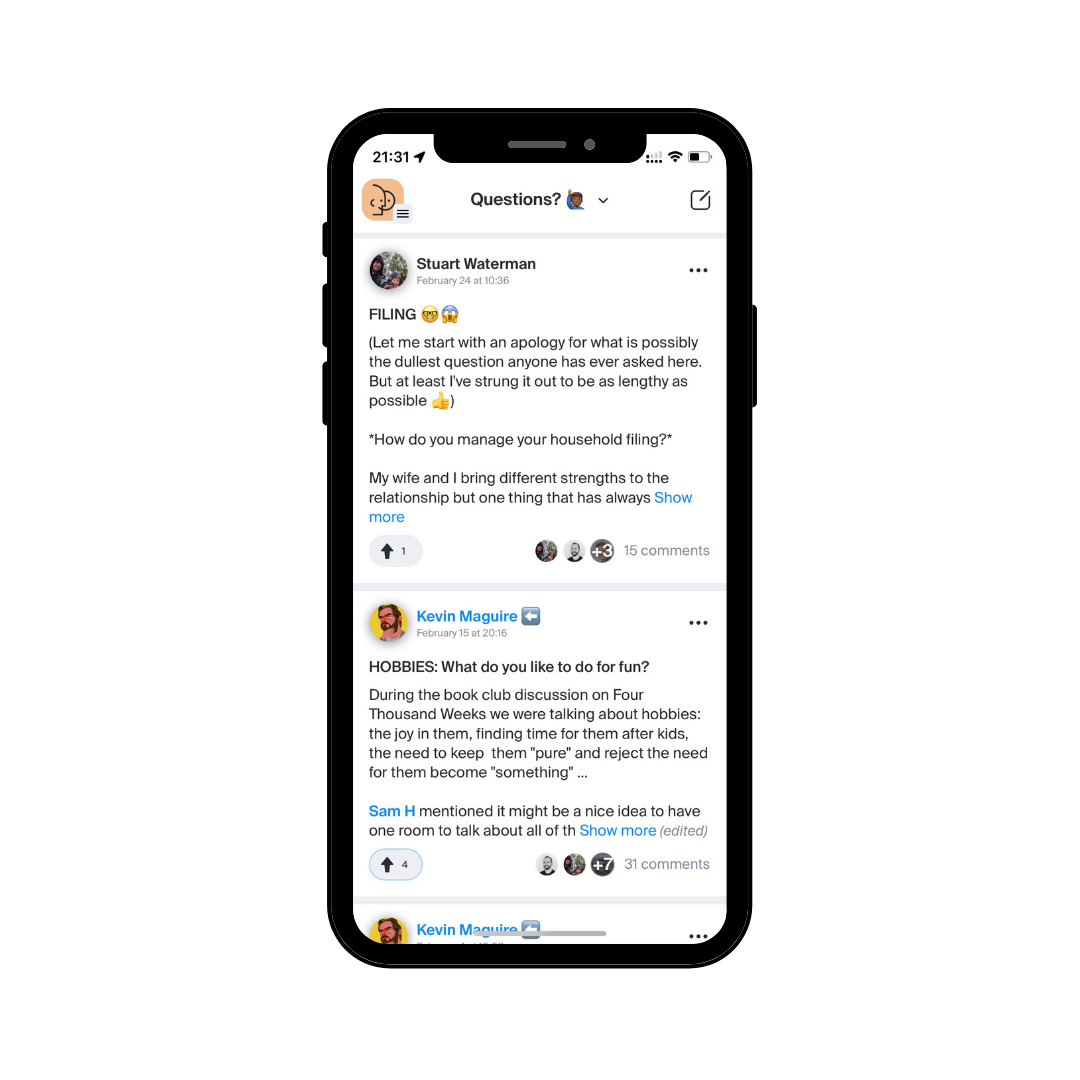
Finishing off a bit of light housekeeping for paid members is a reminder about TNF community on Geneva. You might have thought you didn’t need another feed to keep an eye on. Or you popped in once in the early days and haven’t been back since.
If you’ve gotten to the bottom of this email, and find yourself with a few free minutes this weekend, install the Geneva mobile app (which has gotten much slicker, especially on Android) or MacOS app and come on in for a look around. It feels like there’s virtuous circle between the weekly essays and the discussions we’re having in there, and I’m loving all of your input and suggestions. I kicked off a conversation last month about talking fatherhood with your own dad, and was pleased to see I wasn’t alone in an inability to do so. And for those who could they shared useful structures I might be able to work with. I am loving the issues and insights you’re raising in there. Long may it continue. In an attempt to entice some of you back, I peer pressured a few dads into why they’ve been finding it useful:
“I never knew I needed a community of dads until I found The New Fatherhood. It’s made me feel that I’m not alone in the everyday titanic struggle of raising little Homo sapiens, and it’s giving me the tools to be a better dad for the next generation.”
“For all its boons, being a dad can be a lonely old business sometimes. Having this community to ask questions, to vent to, to share passions with, and just to have connections with like minded people who are also in the trenches with me, has been invaluable for me as a new dad. Plus, I've been introduced to a bunch of new books, music and TV shows, which if we're honest, is what this is really all about, right?”
“I'm a few months into fatherhood, and this week I've come to the realisation that I do genuinely love being a dad. That's in no small part due to this community. Thanks to all of you.”
“For a bunch of guys I’ve never met I’ve come to value your opinion an awful lot. Far more than some of my friends to be honest.”
Thanks to the very helpful dads who came through, to those who have been sharing their experience, warts and all, and to everyone who continues to support TNF.
Have a great weekend.