


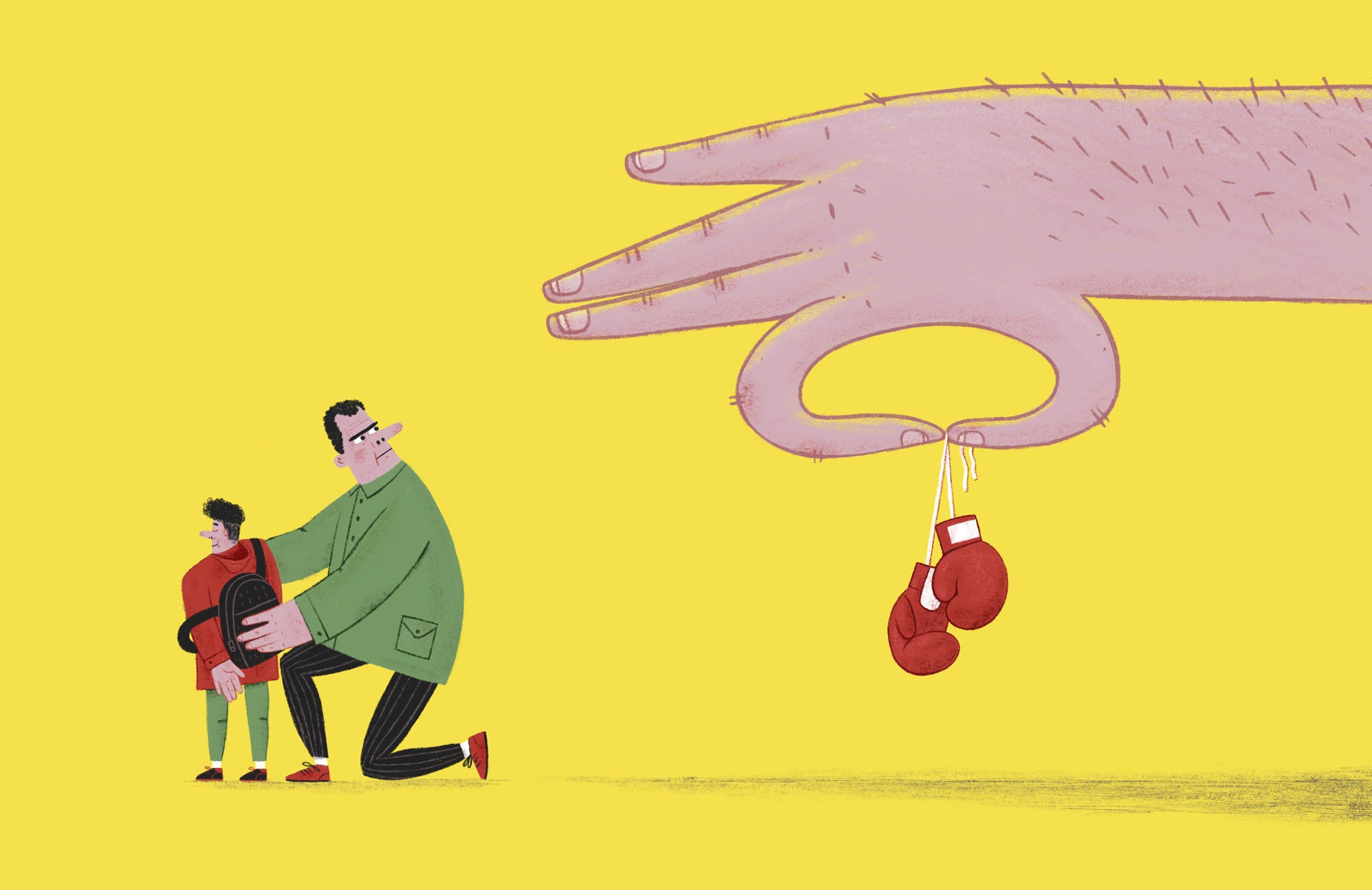
One of the best decisions I ever made was inviting my friend Aaron to punch me in the face.
It was almost four years ago. My daughter had recently started boxing: a kids’ class at a local gym, one evening a week with other kids her age. I told Aaron how great it had been for her: improving her confidence, meeting new friends, and learning how to throw a punch, should she ever need to.
So he started sending his daughter. And while our offspring spent an hour running, jumping, and punching (at an age-appropriate level, in a controlled environment), we’d sit in a local plaza, talk over beers, and whatever tapa del día was on the board. We’d wander back, pick the kids up, and they’d show us what they’d been practising: the hooks and uppercuts they threw, the bobs and weaves to get out of the way.
Yup, it helped their confidence. Maybe a little too much? Soon after came the smack talk: “HEY OLD MEN … now we could beat you in a fight.” Those are fighting words, girls. They’re probably the most direct fighting words you can use. Our weak egos could only take so much, so we bit the bullet and signed up—twice a week, roping in two other friends who also wanted to start.
Four friends, with very distinct second places: restaurant-runner, journalist, author, whatever-the-hell I am. Workplaces that range from the quiet desks of public libraries to the fiery kitchens of Michelin restaurants. We’d never have met each other through work. In a field, with music blaring, sure. But the boxing gym became our new third place.
We signed up to meet every Tuesday and Thursday morning. Sessions alternated unpredictably between cardio and technique. You’d never know which would be waiting for you as you walked in, bleary-eyed. On some cardio days, I’d leave the gym half-expecting to throw up on the way home, my attempt to plank until failure looking like a Full Metal Jacket outtake.
We worked through trainers: Guillem, a particularly sadistic teacher who was considering quitting to join the local police force; Richy, a former boxer who retired in his mid-20s to avoid getting thumped in the face and protect his exemplary jawline for casting directors. We ended up with two regulars: Yomer, a semi-professional (and fellow dad) from the Dominican Republic, and Mounir, a young man who’d recently celebrated his 20th birthday after arriving in Barcelona. The owner, Frank—a professional boxer who has gone the distance with many of Europe’s best—baptised us “Team Daddy.” (Half of us didn’t have kids, but why should the facts get in the way of a great moniker?) Frank would watch instructors put us through our paces, constantly delighted by our laughable levels of fitness, our abysmal attempts to punch in a manner that might be mistaken for “technique.” Watching us spar must have felt to them like watching my son’s judo practice: “Bless, they’re all trying so hard, isn’t this adorable?”
Sparring a friend is a particularly singular experience. When was the last time you were in a fight, throwing and dodging punches, with anyone, let alone someone you know? You don the headgear, tap in the mouthguard, and watch from your corner of the ring a man who, every other minute of the week, was one of your boys, wondering how hard he would try to hit you today. Now in my forties, my body isn’t quite what it once was—and it wasn’t all that much to boast about back then—so it wasn’t long until the injuries arrived. I fractured my collarbone and was in pain for a month. I bruised a rib, which proved worse, disrupting my sleep for weeks. “I’m not in pain all the time,” I told the offending friend when he offered his condolences in our group chat. “It only hurts when I breathe in, so only half the time.”
Mum passed away a few months after we started, and I took time off from the classes. When I returned, I had a stark realisation: it was impossible to cry and punch at the same time. I was emotionally wrung out; being physically wrung out felt like a relief. The camaraderie of the group spilt out of the sessions, on the walk to work afterwards, arguing with one of the quartet because he’d been busted watching a classic boxing match on YouTube; in the group chat as we’d laugh at just how laughable the instructors found us that week.
What’s great about becoming a regular at a third place—whether it’s a gym, bar, coffee shop or barbershop—is that you slowly become part of the community, the beating heart of the place. We were invited to travel to casinos and gymnasiums up and down the Catalan coast to watch our trainers hammer seven shades of shit out of other boxers, opponents who were presumably working in other gyms, with other dads. Team Daddy’s family (and restaurant) commitments meant a Saturday night in a casino two hours outside the city wouldn’t work. Then a fight in the city was announced, with both Yomer and Mounir on the card, so Aaron and I decided to show up in their corner.
General tickets were €18. Front row was €42. We decided to push the boat out. Yomer would be up against a fella named Kevin; Mounir, much further down the card, would be fighting who-the-hell-knows: “All I know is that I’ll be on around 8pm,” he told us. We took the metro to the outskirts of the city, unsure what would lie at the end of the dotted blue line I was following. It was a school gymnasium, eerily quiet at the entrance. Were we in the right place? We needn’t have worried—the hall was packed, with rows of plastic chairs folded out around the ring and wooden bleachers on one side giving the crowd an elevated perspective. We were ushered to our seats and watched two fights before the MC announced Mounir was next. Looking towards Aaron, I saw his face reflecting exactly what I felt in the pit of my stomach: butterflies. “I’m a mess … this strange combination of nerves and pride,” I offered. “This is how I feel when my daughter is walking up for her end-of-year drum recital.”
Aaron felt the same. Whatever was happening here was firing all our dad neurons. Mounir made light work of his opponent. He was fast; the other guy wasn’t, and struggled to land a single solid punch on him.
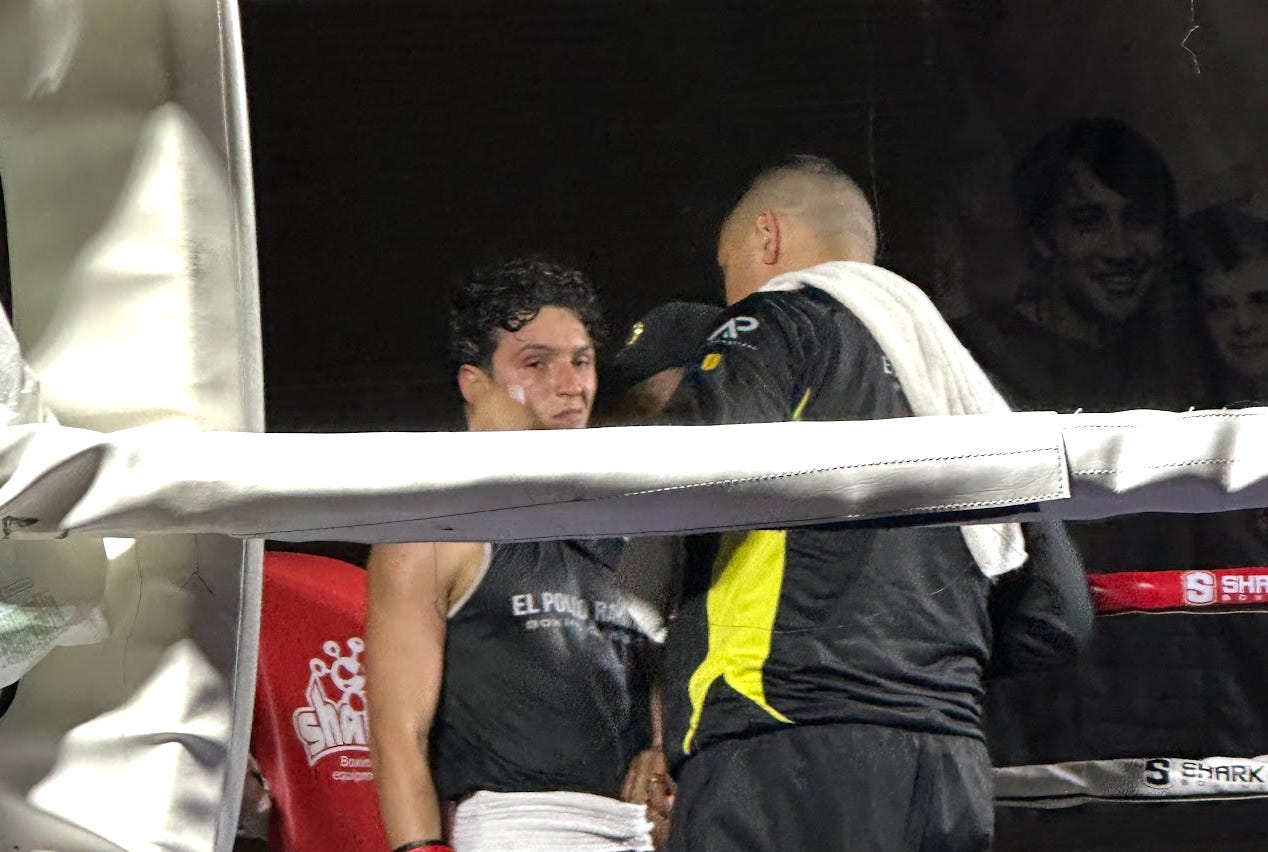
Yomer came an hour later, a fight that felt more visceral: a different weight class, more muscle and power, crunching hits that made my rib and collarbone echo in despair. On the edge of our seats, we cheered as Yomer pummelled my namesake—the other Kevin pushed deep on the ropes next to us, a right hook connecting with Kevin’s left cheekbone, beads of sweat flying through the air, glistening as the floodlights passed through them, falling to the floor mere feet from our seats. In the third round, Yomer ducked under a wild right hook, shifted his centre of gravity, put power into his hips and wound up a left body shot. It came fast, hit hard, and Kevin crumpled to the floor.
Heading back to the metro, heads still buzzing from the evening, we vowed to do it again. It was the best night out we’d had all year—a completely new experience, and how often do you get to do those these days? I started boxing because my daughter learned to throw a hook and threatened to use it. I carried on because it was good for my physical health. But the mental health benefits came smuggled in the back, under the guise of fists and friends.
As Aaron and I got onto the train, we noticed Mounir and a friend across the carriage.
“You look worse than me, and I just fought three rounds,” he jabbed.
“You may have fought three rounds,” I hooked back. “But you don’t have two kids.”
3 things to read this week
A lot of good parenting fodder in the paper of record recently.
“I Once Celebrated Marriage. Things Have Changed.” by Curtis Sittenfeld in The New York Times. What would you say to the about-to-be-married version of yourself? Sittenfeld gets to find out, annotating her 2015 essay eleven years and one divorce later. The certainty is gone; in its place is the painful admission that she and her ex hurt each other badly. Come for the story, stay for the excellent web design and UX work.
“In Fighting for Every Black Child, Did I Betray My Own?” by Nikole Hannah-Jones in The New York Times Magazine. Ten years ago, Nikole Hannah-Jones put her kindergartner on the cover of the Times Magazine to explain why she’d chosen a poor, segregated school for her. She still gets emails from parents saying it changed their minds. Now her daughter, Najya, is 16 and has been on both sides of New York’s divide: years of low expectations, then a selective high school where she was suddenly behind and casually insulted. Hannah-Jones doesn’t let herself, or anyone else, off the hook: “There is no absolution here. Not for me. Not for you. Not for any of us.”
“Her Brand Was Tradwife. Now She’s Divorced.” by Amanda Hess in The New York Times. I’ve long harboured a theory that the tradwife movement is being puppeteered by conservative men behind the scenes. Amanda Hess’s profile of Bernadine Bluntly, a former trad influencer and mother of six, doesn’t prove it, but it does give a look inside one marriage: she made the content and the money, and her husband signed off on it as the boss. She left in 2025 and now warns other women off the life she promoted. She says of the years before: “I felt like I was being erased.”
Tell Me About You
It’s been years since I last ran a survey here. Back then, I learned some interesting things, like 1 in 8 of you were women, and you really didn’t want more emails in your inbox. It’s been a while, so I’d love to hear from you again. Please fill out this survey; it’ll take 5 minutes, and I’ll send four dads (or maybe even three dads and one mum, if the ratio has shifted) $25 vouchers for bookshop.org or your local equivalent.
Great, Now I’m Crying Again
 Tiktok failed to load.
Enable 3rd party cookies or use another browser
The New Fatherhood is made possible thanks to the generous support of 297 dads around the world who work tirelessly pay a few bucks a month to keep this newsletter free for everyone else. Throw your hat in the ring and join their inimitable ranks today.