


I once saw a guy wearing a T-shirt that said, “I’m not a stepdad, I’m just a dad who stepped up.” This week, I’m handing over to Scott Curran, founder of Beyond Advisers, author of the book Better Good, and father to two teenagers, who shares a ripping yarn and loving tribute to the doctor who brought him into the world and who would later step up and become his father. Over to you, Scott.
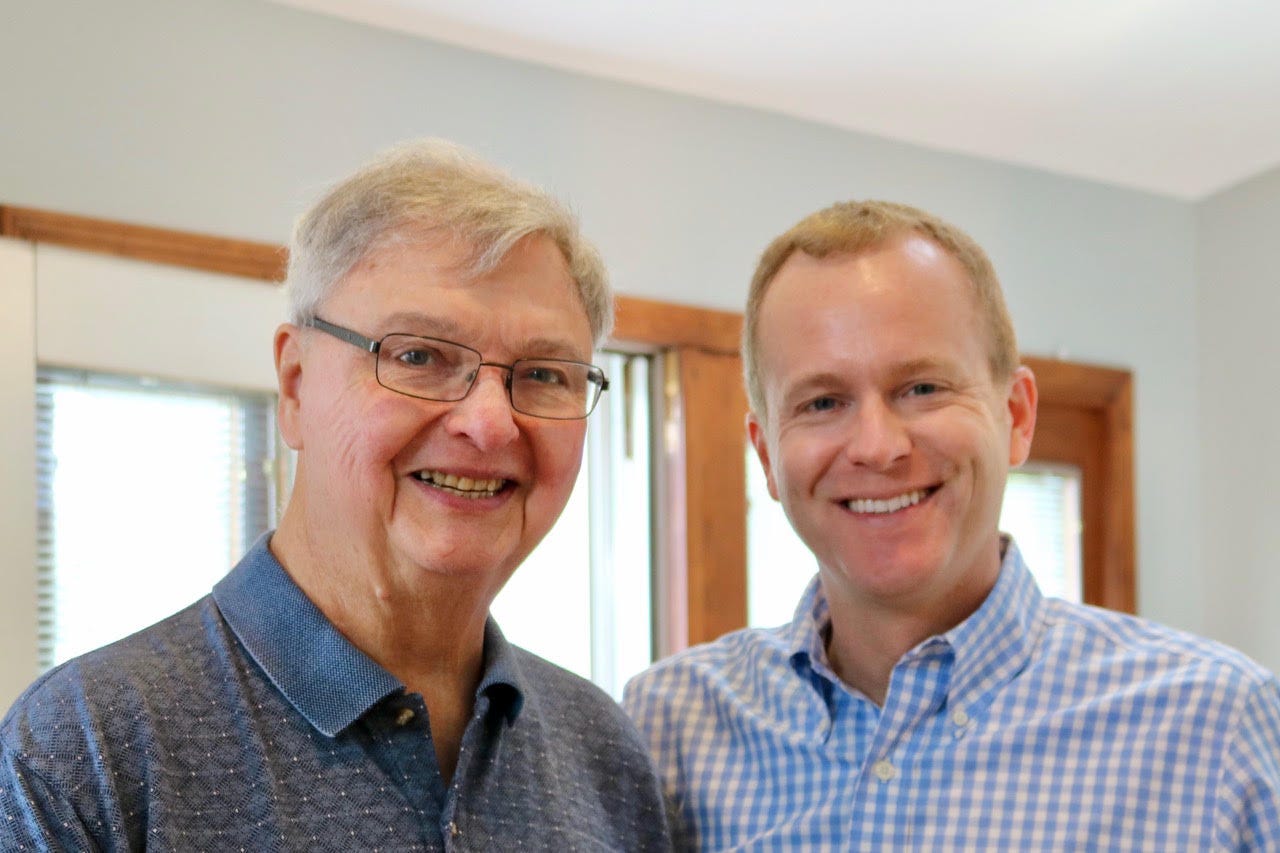
The first memory I have of my adoptive father transports me back to Darien, Illinois, at the dawn of the 1980s. I’m four years old, in the space connecting our dining room and kitchen, sitting on a stool as I watch the grown-ups prepare dinner for our newly blended family. The man in the kitchen is Chris Curran—just “Chris” to me, but I hear my stepsiblings calling him “Dad.” While I’m used to it, my growing brain prompts me to think that I’m also a little confused by that. Chris is married to my mom. He takes care of me and my brother, Steve. We all live together, quite happily.
And so I pipe up and ask, “Hey, Chris, can we call you Dad too?”
“Of course,” he replies, nodding with a smile. (I never called him Chris again.)
Dad’s first memory of me was a bit more dramatic. It was in the labor and delivery ward of La Grange Memorial Hospital on the morning of August 17, 1976. My mother, Lois, was in the middle of her nursing shift. I wasn’t due for five more weeks. But apparently I was eager to make an entrance. Dr. Chris Curran happened to be the obstetrician on call that day. He delivered me, all 5 pounds and 6 premature ounces, never imagining his future role in my life, or mine in his. In retrospect, it almost seems preordained that my adoptive dad was present for my birth, because if there’s one thing he taught me about fatherhood, it’s the importance of being present for your children.
By the time I was born, my biological father was practically out of the picture—I have no recollection of him from this time in my life. His marriage to my mother had been unraveling, slowly at first, and then, as he was confronted with the reality of a second child, not so slowly. (Like Hemingway’s famous line about going bankrupt: “Gradually, then suddenly.”) He stuck around for another six weeks before leaving. From that point on, his presence in our lives was intermittent at best.
For a while, it was just the three of us. Mom was holding down two jobs and struggling to support her pre-school-aged sons. (We ate a lot of SpaghettiOs in those days.) She would often drop us off before dawn with whatever babysitter was available and retrieve us late at night. Our angel during this time was Yasuko Wainwright, though we called her Auntie Yashi—a selfless, strong Japanese woman with a heavy accent, who offered to care for us every day while Mom was at work. She became a surrogate parent, along with her American husband, “Uncle” Ken, who was probably the closest thing I had to a domestic father figure at that point in my life.
Back in the labor and delivery ward of La Grange Memorial, Mom and Dr. Curran were navigating the dissolution of their respective marriages. A friendship blossomed. And then something more. And then, on August 31, 1979, they got married. I still have a picture of Auntie Yashi holding me on the dance floor, another formative image that I’ll cherish for the rest of my days.
Born in 1934, Dad was strong but gentle. His financial frugality belied an ability to live a much flashier life, as many other doctors did. Despite his profession as a physician, he was chronically overweight, with a 6’2” frame that carried dangerously more pounds than it should for most of his adult life. My mom, brother, and I moved out of the tiny little house where we’d been living and into Dad’s four-bedroom Colonial at the end of a big cul-de-sac, where the neighborhood kids blissfully played outside, rode bikes, and, during the long Chicago winters, piled the snow into huge mounds that we would sled down and build forts in.
When I was in the fourth grade, I changed my surname to Curran. It just made increasingly more sense to match. A few years after that, Dad legally adopted Steve and me. Our family, like many others in the seventies and eighties, became a real-life Brady Bunch. We were lucky that pop culture had caught up with the times. The U.S. divorce rate peaked in 1980 (22.6 divorces per 1,000 married women, in case you were wondering). More and more families looked different than the idealized midcentury benchmark set by the Cleavers—now you could turn on the TV and see all sorts of non-traditional domestic units, from Diff’rent Strokes to Who’s the Boss? to Silver Spoons.
Dad raised my brother and me as if we were his own flesh and blood. He was loving, nurturing, and highly engaged, cheering us on at our soccer games, encouraging (but never pressuring) us to achieve in the classroom with an eye on the future, supporting my Space Camp adventures, and meting out measured discipline when we screwed up. By the nature of his profession, he was also very busy, often working long and inconsistent hours. I grew accustomed to dinner-for-three, or hearing the garage door open and the car start late at night. But as much as I would have liked to see more of my dad on any given week, I knew he worked hard and that his job was important—that what he did mattered. Friends of mine he’d also delivered, and their parents who were patients, spoke of their admiration of him in ways I understood and was proud of.
I also knew that Dad believed in quality over quantity. If he wasn’t on call or maintaining office hours, he was usually with us—and by “with us” I mean physically, mentally, and emotionally. That was the silver lining of having a father who delivered babies for a living: he couldn’t bring his work home with him. Well, except for me.
Like my fellow Gen X-ers and Xennials, who got married and had kids later than our parents did, I grew up in the analog age only to find myself building a career and raising children in a hyper-connected world—a world where the line between home and the workplace has become blurred, if not completely transformed; where your colleagues are never more than an email or a Slack message away and it can sometimes feel impossible to unplug. It’s a double-edged sword, this world: more feasible than ever not to be chained to a cubicle eight hours a day, five days a week, but also more feasible than ever to keep working even when you’re not supposed to be.
That’s why I’m grateful for the example my dad set. During the times when he wasn’t on the clock, he gave us one hundred percent of himself, and invited us to do the same. It’s an example that has carried me through my own experience as a father.
Keeping that promise to my son and daughter hasn’t always been easy. For the better part of a decade when they were little, I traveled every other week as an attorney for the Clinton Foundation. For the past 11 years, I’ve juggled the responsibilities of starting, leading, and growing my own consulting firm, co-founding a booming peer education business, and writing a bestselling book to boot. Given that there are only so many hours in a day, I’ve always been intentional about the time I spend with my now-teenage kids. So has my equally busy attorney wife, Amy, for the record.
From the very beginning, Amy and I made a deliberate decision to put our phones away after work until bedtime stories were finished and both of our littles had drifted off to sleep. Over the years, we’ve looked for ways to maintain that focus on being present, some of them big, some of them small. Now that our kids are seventeen and fifteen, we prioritize dinner together as often as possible. We go to the grocery store together, run errands together, go to school events—and now on college visits—together. We even sit around on the couch together in the evenings—either with our homework or our work-work—instead of retreating to different corners of the house. It’s not lost on me that, in another two years, neither of my kids will be in this house anymore, so you’d better believe I’m making every second of my remaining early-stage dad-time count.
I acknowledge that it’s a privileged position to be in—to talk about being together, taking vacations, college visits, making big plans. But for those of us who can manage to make it work, being intentional about our bandwidth means doing things for our kids that our own fathers may not have had the opportunity to do for us. When the opportunity arises to be present, wherever that bandwidth allows, we must be truly, intentionally, deliberately present.
Of all the lessons I hope to pass on to my children, that may be the most important. They’ll have their own ambitions, careers, relationships, and perhaps families of their own someday. Life will pull them in a thousand different directions, but my hope is that they’ll remember what it felt like to have parents who were fully present for them, and that they’ll carry that feeling forward into the lives of the people they love.
My dad, Chris Curran, died on May 12, 2023, at the age of 88. A fall and devastating brain bleed had brought him to the hospital and, ultimately, hospice. Nearly 47 years earlier, he’d been the doctor who delivered me into this world. Now, as he prepared to leave it, the roles had reversed. In those final days, our family gathered around him. My mom, my siblings, our spouses, his grandchildren, and the people who loved him. We held his hand. We talked. We remembered. We spent time together, with him and with one another. In those moments, I began to more fully appreciate something about the lesson he’d spent a lifetime teaching me: The gift of presence eventually comes full circle.
Chris Curran was there when I took my first breath. His family was there when he took his last. In the years between, he taught me what it means to be a father. And the lesson I hope to carry forward, and pass on to my own children, is as simple as the answer he gave a four-year-old boy sitting on a stool in the kitchen all those years ago: Be there. With love, acceptance, and gratitude. Without hesitation. Always, and in all ways.
3 things to read this week
“Meet the Indoorsmen Who Enjoy the Great Outdoors From the Couch” by Natalie Berry in The New York Times. Last month’s guest essay had Sam Hendrix wondering whether camping with small kids is actually enjoyable, and landed on the concept of Type 2 fun: miserable at the time, great in the retelling. Millions of men have found a workaround—let someone else do the suffering. Berry meets the fans of Outdoor Boys, where a former attorney builds shelters in Alaskan blizzards for more than 20 million subscribers. One viewer calls it “survival and chill.” Another sees something bigger: “It genuinely feels like the antithesis to the manosphere and Andrew Tate.”
“Six Selfish Reasons to Have Kids” by Kevin Kelly in KK. Before the pill arrived in 1960, nobody needed a reason to have kids. Now that not having them is the default, Kevin Kelly argues we need good reasons, and that selfish ones are perfectly legitimate. The Wired co-founder lists six, from passing on your values to the kind of unconditional love adults rarely get from anyone else, including one that I’m increasingly experiencing: “As your children age, they will keep surprising you.”
“Meet the Sad Wives of AI” by Alessandra Ram in Wired. Most of what we read about AI is about jobs, productivity or data centres. Very little is about the effect it is having on families. Alessandra Ram writes from inside one: a Bay Area mum whose husband is one of the many dads who’ve gone all in on AI. Near the end, he catches a few minutes of Train Dreams, the film about a man who leaves his family to work on the railroad and asks if that’s what he’s doing, before offering the same excuse we’ve heard from so many dads who barely see their kids: “But I’m doing it for our daughter.”
Good Dadvice



Signing Off
How’d ya like them apples?