


1.
Italia 90 was the first real football tournament I remember. I was seven years old.
I grew up in Manchester, England. But I was, and will always remain, the son of Irish immigrants. Twice a year, every year, we’d head home—it was always home, in a way England would never be—to visit our grandparents, to see the many uncles and aunts my parents once shared a home with, to spend time with as many of my 47 first cousins as we could. At three years old, I was dropped off at nursery with an Irish accent, having learned to talk by imitating my parents and extended family.
In a bout of synchronicity, my first World Cup would also be the first for the Irish football team, finally qualifying after 56 years of unsuccessful attempts. It was a moment of national pride. The team came together under the watchful gaze of “Big Jack Charlton,” who had previously been part of 1966’s World Cup-winning England team. Ireland had a fantastic run, in what would still, thirty-six years later, be their finest ever World Cup finish: one of the last eight teams in the tournament, quarter-finalists, gallantly losing 1-0 to the hosts on a Saturday night in Rome.
The team were greeted as heroes on their return to Ireland, with half a million Dubliners lining the streets and waving the tricolour flag. Jack Charlton became a national hero—a rare Englishman who was celebrated without an Irish ancestry; who stayed English throughout, and was celebrated nonetheless. For those unfamiliar with the history of Irish-English diplomatic relations, this was far from the norm: Ireland was the country where the English learned to cut their colonial teeth, perfecting their tools of conquest—plantation, dispossession, martial law—before exporting them across the Empire. For a family who grew up in the northern counties, garrisoned by British troops well within living memory, an Englishman becoming a national hero was no small thing.
But in those balmy Italian evenings, a new generation of Irish heroes was born, with an Englishman among them. And a lifelong love of football was embedded in a young boy that continues to this day.
2.
Jack Charlton’s younger brother Bobby also won a medal in 1966. But, for my money, his greatest achievement would come two years later, as he was part of the first English club to lift the European Cup (what we know now as the Champions League) with Manchester United. He did it playing alongside George Best, a player who had done the opposite of what Jack Charlton would do years later: born in Belfast, heading to England, a key part of the team I’d eventually be born into adoration of.
Pelé called Best the greatest player in the world. His performance on the pitch, his ability to hold the ball close, waltz past defenders, and drive his team to trophies would later be echoed in Maradona, Messi, and the myriad players who would wear the term GOAT at some point in their careers. But, in a behaviour that would become oft-imitated in years to come, he was as famous off the pitch as he was on it. He’d regularly be photographed by British paparazzi leaving clubs in the morning, with a beautiful model (or two) hanging off his arm. He claimed to have slept with four Miss Worlds, although I can only find details of two: Mary Stävin, a Swedish blonde who would later appear as a Bond girl in both Octopussy and A View to a Kill; and American Marjorie Wallace, who would be stripped of her title 103 days after winning it, having been scandalised in the press for having an affair with both Best and Welsh heartthrob Tom Jones (one would have to assume not at the same time).
Best scored spectacular goals against Portuguese teams with such regularity that the local media gave him a nickname of their own: O Quinto Beatle (”The Fifth Beatle”). Like John Lennon, he’d eventually come to have an airport named after him—something that was, until very recently, a badge to be worn with pride. He lived a life defined by excess, once telling a journalist, “I spent most of my money on booze, birds, and fast cars. The rest I just squandered.” Best spent Christmas 1984 in prison after receiving a three-month sentence for drunk driving and assaulting a police officer. He dealt with alcoholism his entire life, eventually dying from complications because of it. Despite that, he was a hero to so many in my family. But he was only ever a hero I inherited. It would be many years later when a Frenchman, wearing the same crest on his chest, would capture my heart the way Best did for so many of my Irish uncles and father.
Eric Cantona was the ultimate antihero: collar up, defiant, raw brilliance, dripping with what today’s kids would call aura. “Eric the King,” as the flags flying across the Stretford End would proclaim. “1966 was a great year for English football,” recalled a memorable Nike billboard outside Old Trafford. “Eric was born.”
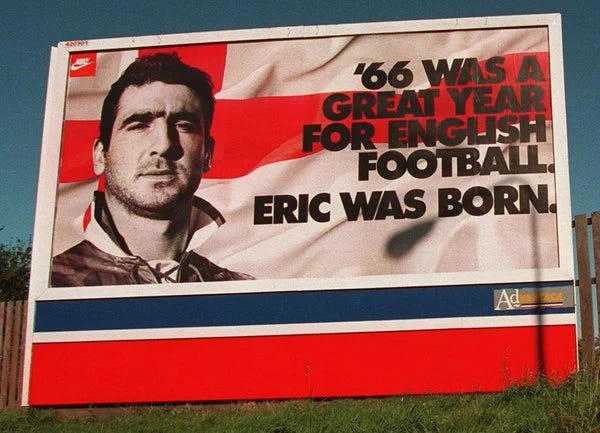
But, once again, we were offered an imperfect hero, with blemishes of his own. On the pitch, his moments of genius would regularly be interrupted by bouts of rage—stamping on players as they came in for tackles, throwing punches at defenders who’d pushed him far enough to let the red mist descend. In January 1995, weeks after I turned 12, Cantona was sent off in a game against Crystal Palace. An opposing fan ran to the side of the pitch and screamed that Cantona should “fuck off back to France you French motherfucker.” Cantona, in seconds, launched himself over the advertising hoardings and placed the sole of his right football boot, and the studs attached to it, squarely into the fan’s chest. He’d earn himself a £30,000 fine (shattering the record for the most severe sanction ever handed down to a player in the English league), an eight-month ban, and my admiration forever.
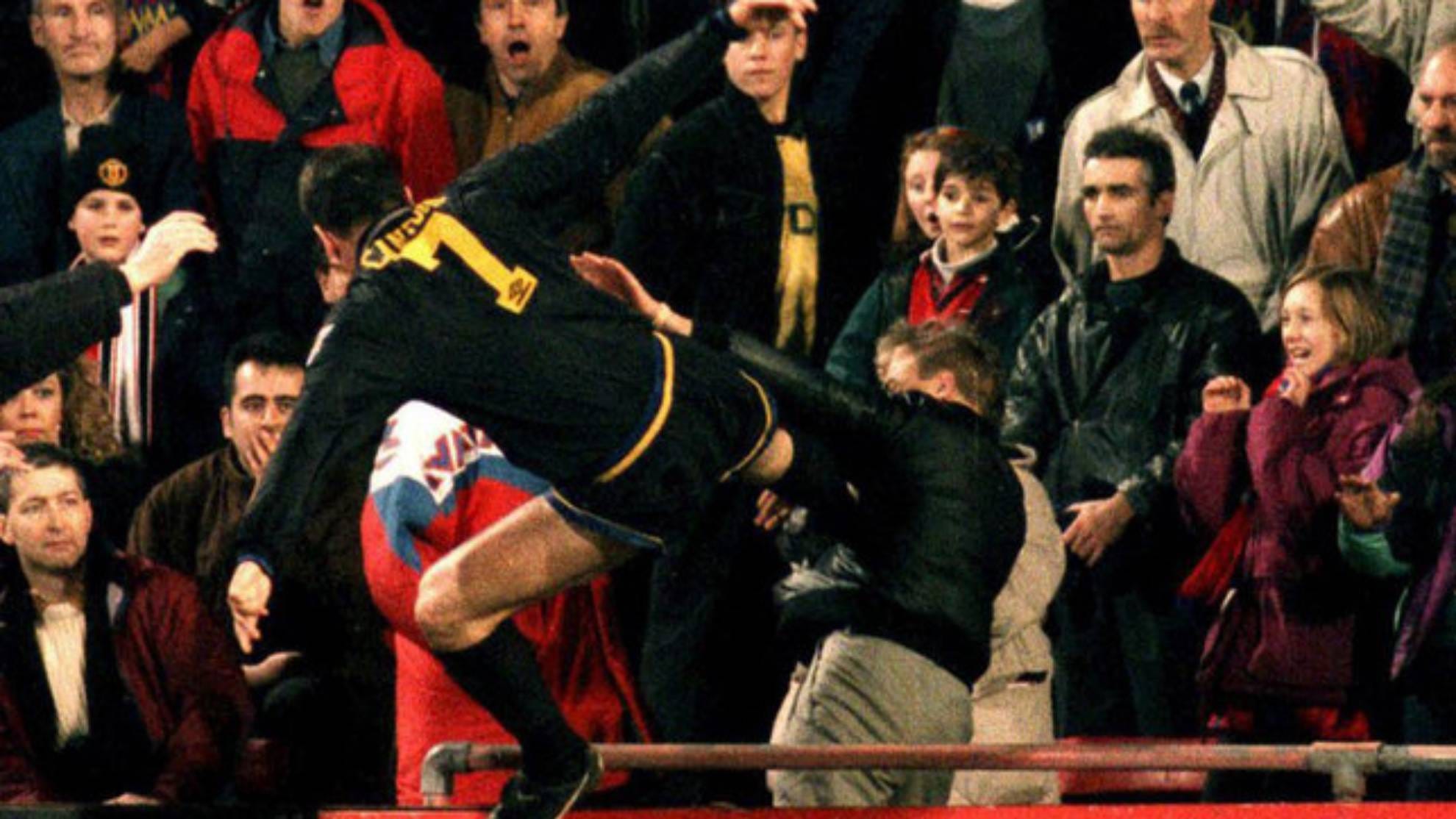
Years later, reflecting on his career, Cantona shared, “I have a lot of good moments. But my favourite is when I kicked the hooligan.” Any regrets? Rather than offering the classic French Non, je ne regrette rien, Cantona only wished “I’d have loved to kick him even harder.” These were the heroes I was handed: majestic but broken, adulterers, alcoholics and brawlers. I held them close. Because what else was on offer? But if modern fatherhood sees us reckoning with what we’ve inherited, and actively deciding what to hand on to our children, we must ask: are these the heroes our children deserve?
3.
I’ve watched every World Cup since that first one, back in 1990.
But this year, it hit different.
It wasn’t just that we live in Spain now. It’s that I live with a boy who is more obsessed with twenty-two men kicking a synthetic leather ball than I ever was. My son’s passion for football kicked into another gear over the last 18 months. All he wants to do is play it, talk about it, collect cards, trade them with friends, and total strangers, at the weekly swap meetup here in Barcelona.
The crass commercialisation of the World Cup succumbed to new depths this year, both on the pitch and off it: hydration breaks so US broadcasters could squeeze more ads into the game, the gauche Louis Vuitton trophy case they awkwardly unveiled at the final, two pages of the Panini sticker album that could only be filled with the stickers found on the inside of Coca-Cola labels, leading fans to start peeling them off in-store, grabbing the stickers and leaving the sugar-laden drink behind.
We picked up a sticker book of our own—now officially designated an endangered species after FIFA announced their 60-year partnership will end after the 2030 World Cup—and got to work getting it filled. When the tournament started, I printed out the BBC wall chart, enlarged it in Pixelmator so it would cover four A4 sheets, and carefully trimmed and glued them together. Every morning, we’d wake up, watch highlights from the overnight games, have our breakfast, fill in the chart, before falling down YouTube rabbit holes of great goals from World Cups past.
We watched every Spain game that wasn’t broadcast at stupid o’clock. The red carpet wasn’t rolled out, but the temporary mattress was—it took pride of place in the living room. Every night, he took a bathshower (our house term for “standing in the bath and getting scrubbed and sprayed whilst the handheld shower was pointing his way”), got into his pyjamas, or much more likely, the counterfeit Spanish away shirt that we bought for twenty euros en la playa, and settled in for the game.
We watched them ease through the group stages, and into cagey knockout games where super-substitute Merino broke the deadlock. They dominated in their semi-final win over Portugal, in what will almost certainly be Ronaldo’s last game—closing the door on his storied career, filled with almost every glorious moment he could have wished for, but with a gap in his cabinet, and in his heart, where he believes a World Cup medal should be.
It was all over my son’s face, and written in sweat in the Pedri shirt he asked us to wash the moment he took it off: he had fallen hopelessly in love with the Spanish team and their propulsive progress through the tournament. He had become the embodiment of a young Nick Hornby in Fever Pitch, who “fell in love with football as I was later to fall in love with women: suddenly, inexplicably, uncritically, giving no thought to the pain or disruption it would bring with it.”
On Sunday, his nerves were palpable. At a picnic with friends earlier in the afternoon, Kiko, a Spanish friend and fellow dad, asked how he was feeling.
“I think Argentina are going to win it,” Kiko suggested.
“Me too,” my son replied, a grave look painted across his face.
I went straight for the same line I use every time he expresses fear or doubt during a Marvel movie: “Don’t worry, the good guys will win.” Although this time, I wasn’t sure if I believed it myself. Argentina have long had a reputation as the villains of the tournament. They play their game channelling viveza criolla, a philosophy embodied across the team—and home country—that reflects individualism, blaming problems on others, a lack of respect for the rules and an indifference to the common good. This encourages them to play the game all the way up to, and often beyond, the accepted rules.
It was this belief that drove Diego Maradona to launch his fist—what he later proclaimed was the hand of God—into the air and score the first goal against England in 1986. This was the moment the game will always be remembered for, alongside what happened four minutes later: an individual spark of pure brilliance as he picked the ball up in his own half, spun around, ran past five players and the goalkeeper, scoring what many—myself among them—believe to be the best goal ever scored at the World Cup. In the MCU, the goodies always end the movie as victors, apart from one fateful time: when Thanos clicks his fingers and destroys half of humanity. Was the 2026 final to become Spain’s Infinity War moment?
Carles, another friend, invited us to join him to watch the game at his restaurant, along with his squad of chefs, sommeliers, waiters and washers. I arrived early, tech support on hand to set up the projector and sound system. As the rest of the family arrived, Carles handed my son something he’d been collecting for the last few weeks: a stack of Panini stickers, at least a hundred and fifty of them. They were dutifully offloaded onto the table and sorted into teams and groups as the notes of The Star-Spangled Banner reverberated around the stadium and restaurant alike, the broad stars and stripes as resonant in the shirts on the players’ backs as the flag that was hoisted above them.
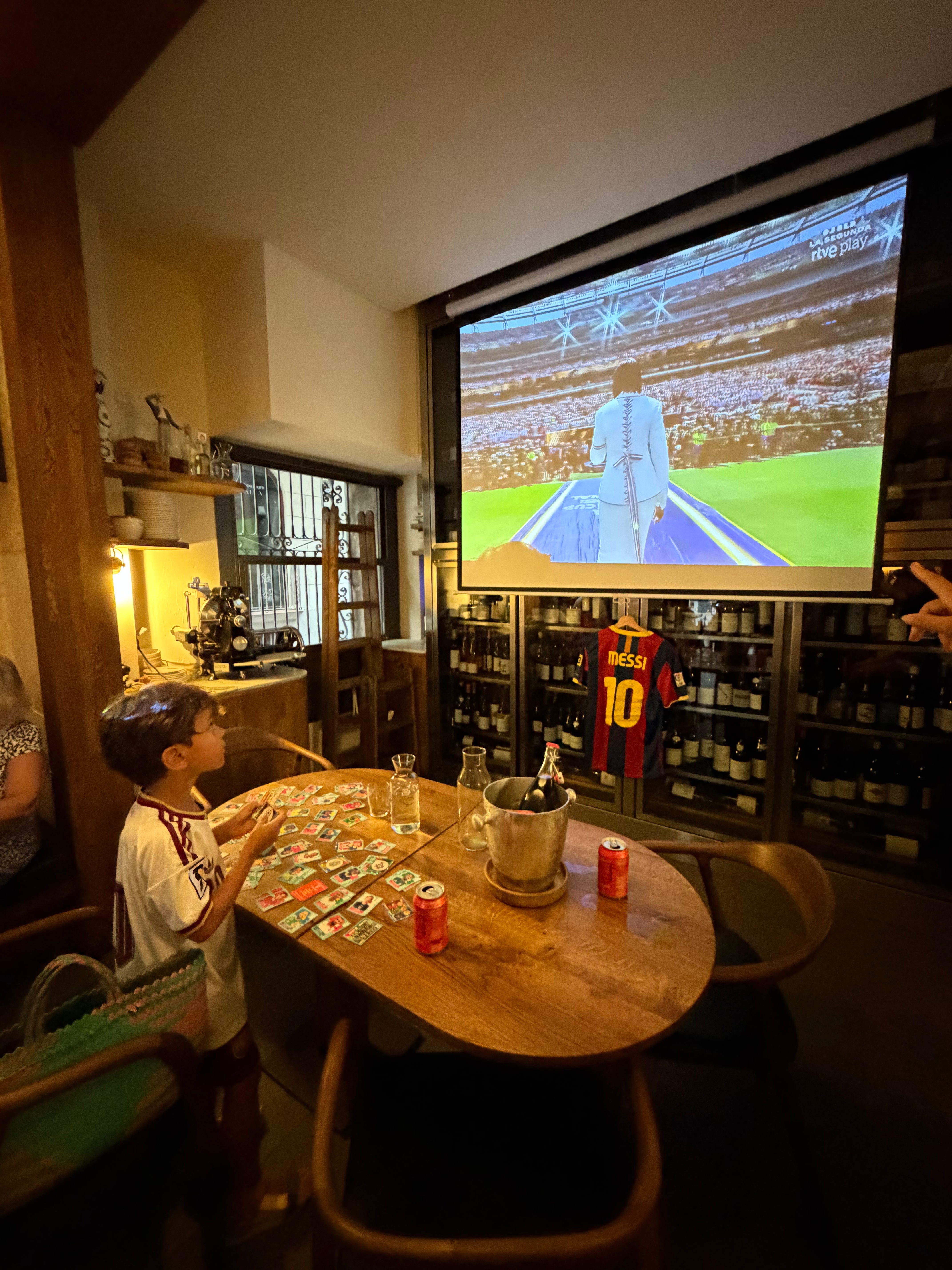
90 tense minutes. Spain dominant, passing the ball around in the same tiki-taka style I watch children play in local parks and playgrounds every day, effortlessly turning defence into attack. Argentina were pressed, unable to manage even a solitary shot in normal time. Into extra time, and a goal felt imminent—and was heralded outside our window a few seconds before, the curse of watching a so-called livestream on the internet, delayed from the terrestrial broadcast arriving earlier via the airwaves. But it wasn’t to be—one of two goals disallowed during extra time.
But solace was to come. The ball came into the box and was headed back across the goal by Nico Williams, falling towards the left foot of Ferran Torres, who launched it past the goalkeeper.
The restaurant, and the rest of Spain, was sent into absolute rapture.
4.
Outside of the universes provided by Marvel and DC, heroes are in short supply for our boys. A 2025 YouGov study of 4,000 18-to-34-year-olds showed half of British and American young men were actively searching for influencers who embodied the qualities they admire—namely kindness, empathy, and compassion. The boys we are raising are looking for heroes of their own. The appetite is there. But the supply chain is broken, and when their search comes up fruitless, they end up in the manipulative arms of the worst people in the world. A 2023 study by British anti-fascism charity Hope Not Hate found that 52% of 16–17-year-old boys held a positive view of Andrew Tate. Last year, the BBC reported an increase in sexism and misogyny in British classrooms, driving teenage boys to question the authority of female teachers and harass the girls in their class.
In that world, it’s only natural that footballers would rise in stature to become the modern men of myth. They’re successful, they’re talented, they’re rich. What’s not to admire? But they are far from flawless gods. And football is a sport that, however adored, must never be beyond criticism. Fans in the 1980s used its tribalism as a mask to indulge the violent behaviour they desired. In Among the Thugs—the best book ever written about football, bar none—writer Bill Buford worked his way into the “football firms” across England that orchestrated the scenes of hooliganism that drove young men to destruction of people and property during that dark spell of football. Some of the beliefs from these years still pervade the modern game, a place where racist incitements both on and off the pitch are still painfully commonplace: take this depressingly long Wikipedia list of racism in football, which spawns far too many racism in [country x] subpages, and runs right up to the present day—a tournament that saw black footballers abused by opposing fans, former players, and even sitting Senators.
Allegations (and cold hard evidence) of racist abuse, sexual violence, and financial corruption mar the modern game. But in a world where heroes are in short supply, and with daily front pages filled with the world’s villains distributing pain and suffering with seeming impunity, where can we look when we want to look up? Is this Spanish team, playing the so-called beautiful game, worthy of my son’s adoration? Is the pitch filled with men I’m happy to see him idolise?
There are moments stacked in the column against. Alongside the racism comes the latent sexism in the game: women’s football as the butt of the joke, not a cause for celebration. After Spain won the Women’s World Cup in 2023, outrage erupted after the President of the Royal Spanish Football Federation, Luis Rubiales, grabbed player Jenni Hermoso by the face and kissed her forcibly. In the ensuing media storm and global furore, Rubiales was defiant, adamant he had done nothing wrong, shouting “I WILL NOT RESIGN” five times at a press conference. It was only after all 23 World Cup-winning players, joined by dozens of others, collectively refused to play for the Spanish team, that Rubiales’ hand was forced.
The Spanish striker Borja Iglesias joined their picket line, announcing he’d be resigning from the Spanish men’s side immediately—a male player sacrificing his international career in allyship with the women’s team in a showing of solidarity. Interviewed after Sunday’s game, he said this win was “a continuation of what [the women’s team] did” in 2023. Rodri, given this year’s coveted Ballon d’Or and crowned player of the tournament, was interviewed by Aitana Bonmatí, herself the winner of the same title three years earlier. Rodri said what had driven him was “admiration for Aitana, and what she achieved. I was trying to copy her, to see if I could get to her level.”
Lamine Yamal and Nico Williams embody the next generation of players: children of immigrants, playing football at the highest level. Yamal has made mistakes of his own—he was investigated for hiring performers with dwarfism as entertainment for his 18th birthday—the kind of blind spot that comes from being handed the world at such a young age. On the eve of the quarter-final game against Belgium, the Spanish press asked him how he dealt with the pressure of playing football in front of millions, the hopes of a nation riding on his shoulders. He questioned the premise: “My mum had me when she was 16. That’s real pressure. My dad had to do whatever he could and pick things up off the streets just to bring food home. That’s real pressure. All I have to do is play football and make the Spanish people proud.”
And how could a newsletter about fatherhood neglect to share the story of Marc Cucurella, whose voluminous hair has become a familiar sight as he has spent the last two months whipping up and down the left side of the pitch. It can’t be easy playing football with hair like that. But he lets it run wild, so that his autistic son Mateo can always spot and recognise him when he’s on the pitch. Cucurella has spoken openly about the difficulties of raising a neurodivergent child, and how becoming a father changed everything—his patience, his priorities, his sense of what winning even means—putting the noise of elite football into sharp perspective.
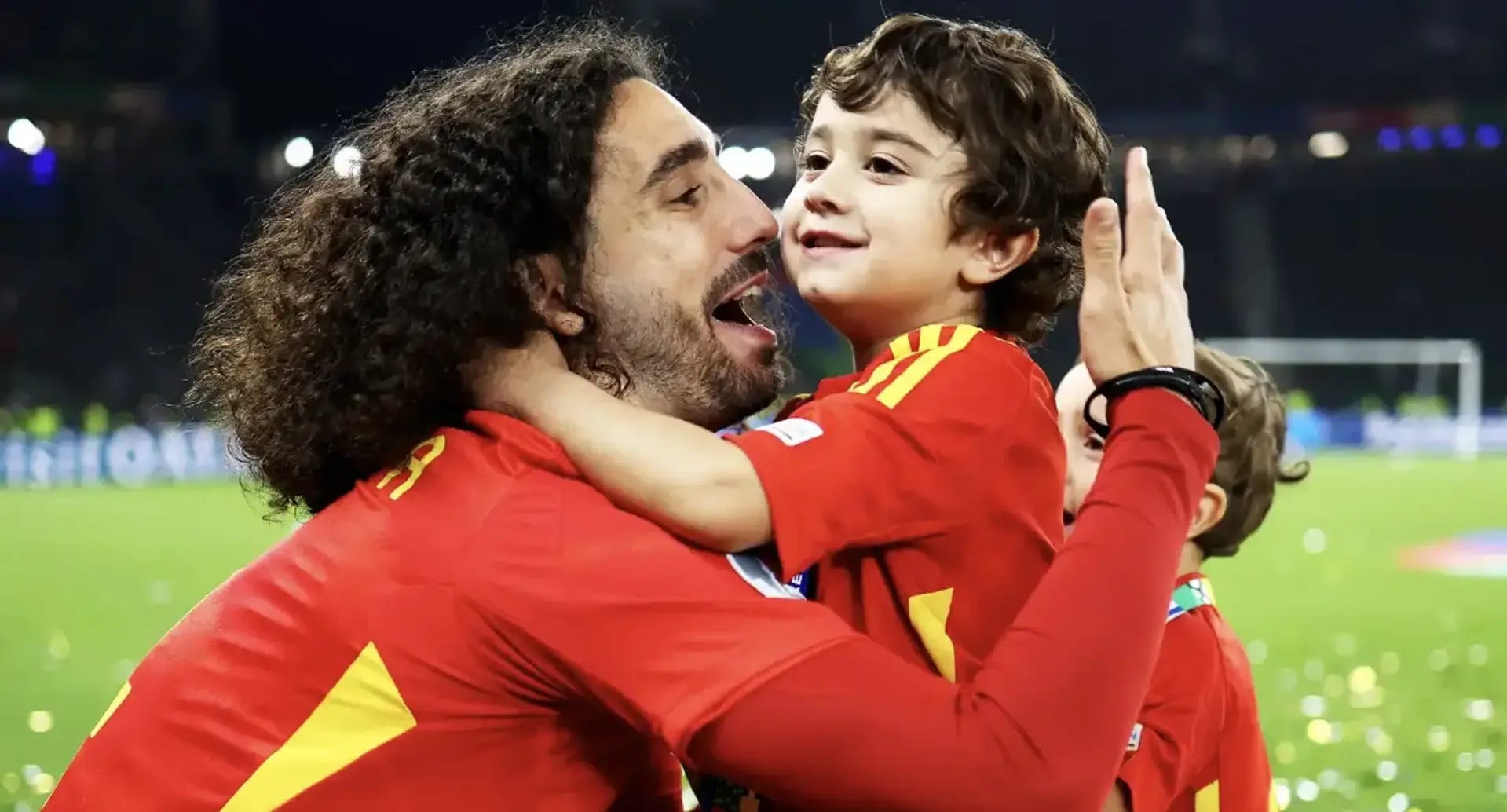
My son and I embraced as the final whistle blew: overwhelmed after five weeks, eight matches, and a final 120 minutes, following his beloved España (and Lamine) all the way to becoming world champions. We walked out onto the streets to cheers, motorbikes flying the Spanish flag, and car horns going until the early hours of the morning.
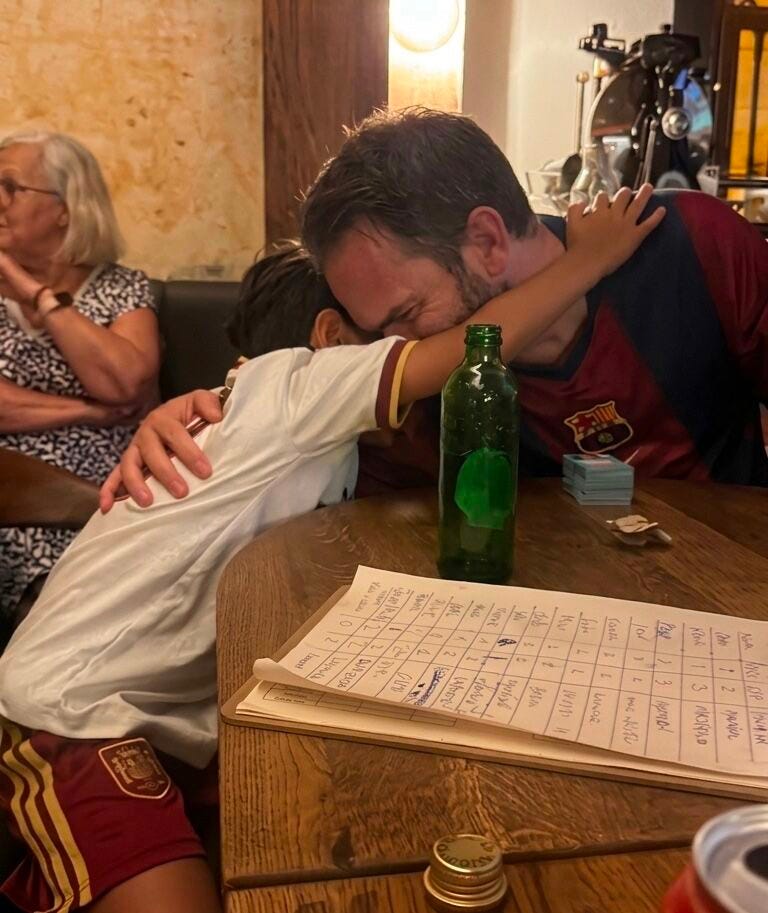
Sunday was a night I’ll never forget, and one that I’m sure will linger long in his memory too. One of the greatest gifts of fatherhood is seeing the world with fresh eyes, and watching their first time become yours all over again. The joy on his face—and tears in both of our eyes—as we watched the Spanish team embrace after the full-time whistle is a memory I’ll hold onto for years.
It had gone 2 am as I tucked him into bed, a cacophony of noise seeping in from the streets. “I’ve never enjoyed a World Cup as much as this one,” I told him. “And it’s because we watched it together.”
“I’ll be 11 at the next World Cup,” he told me.
“You will. And it’ll be here in Spain. If Ireland qualify, maybe we’ll go see them play.”
“What about España? Can we get tickets to watch them?”
“Probably not. But we can try.”
Say Hello
Hope you enjoyed reading this one as much as I enjoyed living it.
Loved | Great | OK | Meh | Bad
A regular newsletter takes one day a week to write. This one, close to double. It came about as I wondered if I could turn a 300-word LinkedIn post into a 1,000-word essay. 3,300 words later, here we are.
If you’d like to support my writing (and our attempt to buy World Cup tickets in four years), you know what to do.
Brilliant article! I understand the appeal of figures like Cantona, the antihero who seems invincible and so different from everyone else. It is really difficult to find heroes that kids can look up to. Here in Brazil, we have a serious problem named Neymar. For some years now, he has become an undisputed idol for many youngsters, even though his behavior keeps getting worse. He cheated on his wife while she was pregnant, supported a far-right president, tried to evade fines and taxes, and uses his platform to promote gambling. I'm so sad that my teenage nephews consider him an idol. Just like some in the media and many influencers, they believed Neymar could lead Brazil to the title. That couldn't be further from the truth. Once a genius, he is no longer someone who should be admired, either on or off the pitch.
Beautifully written. These are the special moments in life. Thanks for sharing.