


I didn’t read my own book this summer, but thousands of other dads did. And so far, they’re digging it: 4.1 on Goodreads and 4.5 on Amazon, which, if I understand rating systems properly—and I’m fairly sure I do—means I wrote something better than Catcher in the Rye but not quite as good as Pride and Prejudice. One dad called it an “absolutely essential book at just the right time in my life,” another said, “even after two kids and figuring out the ‘what to do’ bits of fatherhood, this book was still able to give me insight and perspective on who I am as a dad and ways to be the best father I can be.”
If you haven’t picked it up yet, or you thought, “oh yeah I’ll get that” before your kid’s latest chaotic event pushed it out of your brain, here’s a nudge. And if you bought it, only to leave it atop one of your home’s perilous tsundoku piles, this is your reminder to get stuck in (and then maybe tell a friend or two about it afterwards).
Enough about my book. Let’s talk about an even better one.
All By My Lonesome
Vacation this summer meant attempting a mental break from the internal chatter around my own book. After three years of work, and the first six months of the year spent waking up, going to sleep, and waking again at 4 a.m. to think about it, I decreed I’d spend August doing literally anything else.
So I got lost in the words of others. I took Austin Kleon’s advice to tackle a long read for a long hot season, and saddled up with Larry McMurtry’s Lonesome Dove. Austin had recommended it when I interviewed him for the podcast; his endorsement echoed via others with similarly unimpeachable tastes: Colin Nagy at Why Is This Interesting, Jia Tolentino in The New Yorker, Kevin Kelly at Recommendo, Michael Williams at A Continuous Lean. In 2022, Stephen King declared it “probably my favourite book of all time.” Netflix just announced that they’ve ordered a new adaptation of the book, from the showrunners of the just-dropped-yesterday East of Eden miniseries.
For a piece of literature to be spoken of in such reverent tones, almost forty years after it was released, suggests it is more than a mere Western and has particular relevance to the moment we find ourselves in. But tackling an 836-page doorstopper is daunting. I tried—and you might say failed, but I’ll optimistically say paused—with The Power Broker in 2024, when 99% Invisible ran a companion podcast, and folks shared how-to guides for dissecting it into smaller, public transport-friendly chunks.
Lonesome Dove accompanied me on an adventure of its own, as we set out for the great plains of the United Kingdom. As I was belting up for the journey, another dad walked through the aisle, toddler under one arm, book under the other. I gave him a nod as he walked past—one part acknowledgement of the long narrative journey we’d set out on, the second in solidarity with a dad flying solo with a young ‘un.
I came in expecting a Western. I hadn’t quite prepared myself for a visceral dissection of the American Dream, set half a century before that phrase was thrust into popular culture. McMurtry—who would win the Pulitzer Prize for Lonesome Dove, before later winning the Best Adapted Screenplay Oscar for Brokeback Mountain—told The New York Times that his goal with the book was to de-romanticise the legend of the cowboy. “I don’t feel that it’s a myth that pertains, and since it’s a part of my heritage I feel it’s a legitimate task to criticize it.”
I am far from the first writer to pick up this book, feel it resonate strongly, and question “why this book, and why now?” Last year, Michael Sebastian wrote in Esquire Magazine, asking Why Is Everyone Reading Lonesome Dove? He suggested it could be down to how it brings forward the indomitable spirit of persistence that resides within:
“There are moments in which we fail to act in the manner we expect of ourselves—we’re cowards when we should be brave, liars when we should be truthful, weak when we should be stalwart. Then this notion enters our heads: we will never again be the man we wanted to be […] When the time comes to test our mettle, and we fail, the best possible scenario is that we recognize it, learn from the experience, and push ahead. We have to keep trying.”
Could be. But my read was a little different. I am, forevermore, guilty of seeing things through the New Balance-tinted sneakers of fatherhood. And paternity runs deep through the book, with dads presented in a harsh light that might have been the norm in the Old West, was still prevalent when the book was published in 1985, but is a much harder pill to swallow today. These characters may embody elements of the rugged, loyal, outdoorsy man you aspire to. But they are not the fathers we lionise. That shaped much of my experience with the book, because sometimes anti-role models—vividly painted pictures of the dads we don’t want to be—can be just as powerful as positive role models.
[A few mild spoilers here. Skip ahead to the embedded YouTube video if you’d rather go in blind.]
The book tells the tale of two former Texas Rangers: Woodrow F. Call and Augustus McCrae, known as “Call” and “Gus” to their merry band of men, cowboys and cattle herders who took up the role as the Texas-Indian Wars began to wind down. When I tell you that the 1989 miniseries perfectly cast Tommy Lee Jones as Call, and Robert Duvall as Gus, you should get them fairly quickly. Gus is a man who enjoys life’s simple pleasures, unencumbered by the heavy weight of ambition and expectation. He tells a paramour that “If you want one thing too much, it’s likely to be a disappointment. The healthy way is to learn to like the everyday things.” And those everyday things he enjoys? Sitting on his porch, getting drunk, and flirting with women.
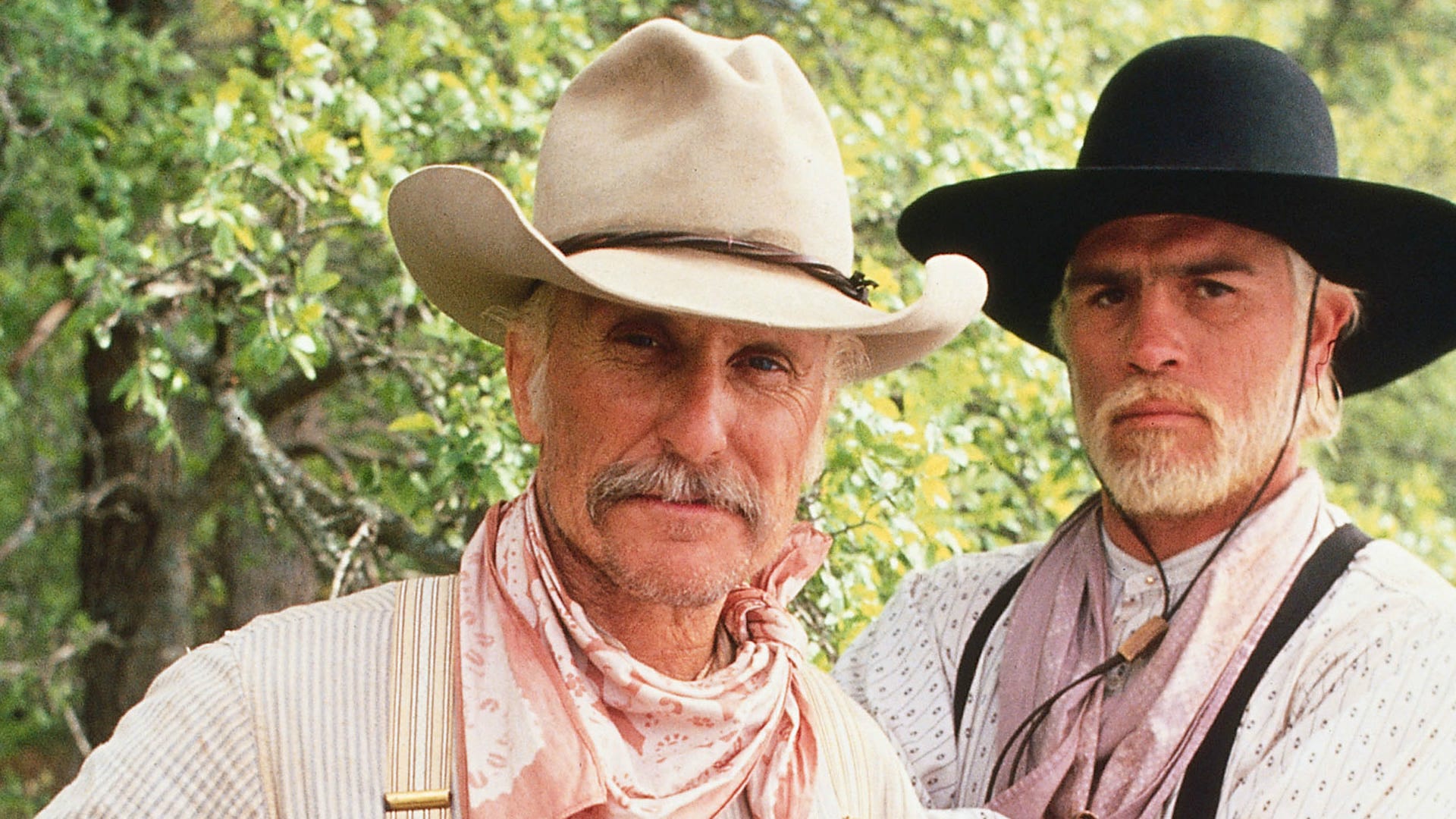
Call is the yin to Gus’s yang—a man deeply unhappy with his lot, who “never seemed to need any of the things other humans needed, like sleep or women. Life for Call was work, and he seemed to think everyone else ought to see it the same way.” As a Texas Ranger, he had purpose, fulfilment, a sense of meaning. And then the war ended, the work dried up, and all he was left with was himself. So what’s a man to do?
If Blaise Pascal was right, and “all of humanity’s problems stem from man’s inability to sit quietly in a room alone,” then Lonesome Dove is that writ large. You spend the early chapters settling into life in a small border town in Texas—lazy days, long sunsets, the comings and goings of regulars shuttling into the Dry Bean Saloon, drunks at the bar, ladies of the night in the rooms above. What seems like a good old life is interrupted as an old friend appears, a cowboy bringing news of pastures way up North, a place called Montana: perfect for raising and selling cattle.
Call immediately decides this is what he needs. A bigger opportunity, a final paycheck. Unfulfilled with his life in Texas, his pioneer heart masks an escape from responsibility as a desire for adventure, a dissatisfaction with life as it is. If it is true that “wherever you go, there you are,” Call is about to find that out for himself—but not before he rallies a posse to travel with him, promising them that the grass is literally greener on the other side of the United States.
As you might imagine, things don’t go to plan. That’s something you should experience for yourself (seriously, go read this book), but I want to call out the fathers in this book, notable mostly for their absence. Attempting to take his place among literature’s all-time deadbeat dads, Call walks out on a prostitute he fell in love with—and maybe the only woman he ever loved—leaving her with a child: a boy she names Newt. Newt grows up, joins Call’s posse, and is generally understood by the rest of the group as Call’s son, but Call never tells Newt this and passes up every opportunity to acknowledge him as his heir. The words just won’t come. He gives Newt his favourite rifle, his prized mare, but not his name.
Unlike Gus, who is happy with his lot, Call suffers throughout the book from what Buddhists call dukkha: the innate dissatisfaction we are all born with, the one we can only make peace with by actively battling it every day. [A more major spoiler ahead—skip this paragraph if you’d rather go in blind.] This discontent is laid bare towards the end of the book, when Gus, on his deathbed, asks Call to carry his body all the way back to Texas, to the small outcropping where Gus once sat watching sunsets with a woman he loved. Call, out of loyalty to a dying friend, does it—turning his back on the new life he trailed through rain and snow to reach, and on the living son who, on the cusp of adulthood, still needs his father so desperately. When a reporter later calls him a man of vision, Call’s reply is the bleakest line in the book: “Yes, a hell of a vision.” Gus had seen it coming: “You should have died in the line of duty, Woodrow,” his friend tells him early in the ride. “You’d know how to do that fine. The problem is you don’t know how to live.”
The Good Old Days
This summer wasn’t just for books. I took on an essential fatherhood project: the first watch-through of the American version of The Office with my daughter. We wrapped on the ninth season around the same time I was finishing the book. In the finale, Andy Bernard—a character I am middling on at best, sitting in my C-tier somewhere behind Bob Vance—drops this stone-cold bomb:
“I wish there was a way to know you’re in the good old days before you’ve actually left them.”
It is a line as much about making that show as the stories in it—you just know they had a blast making it. This might be my fourth rewatch, which is still way behind Billie Eilish’s 30, but I’m fairly sure Billie didn’t spend most of 1993 wearing down a VHS recording of Marge vs the Monorail. Bob Odenkirk would certainly agree with Andy’s sentiment. Comedian Mike Birbiglia interviewed the Better Call Saul star last year and asked him, “Who are you jealous of?” Bob’s reply is worth watching in full, if you haven’t seen it:
“Anybody who’s still got little kids at home growing up. There’s no question: I knew what I was doing when I had kids growing up. I was being a dad. I mean, that was my job, and I didn’t have to ask myself ‘What am I doing here? How can I be a part of this world? How can I be meaningful today?’ I didn’t have to ask that question because the fucking answer is ‘Pick up everything between here and the door and make sure they get to school and have a laugh with them.’ I understood my purpose.”
And this is where the conversation swings to Gary Vee. Wow, didn’t think this day would ever come.
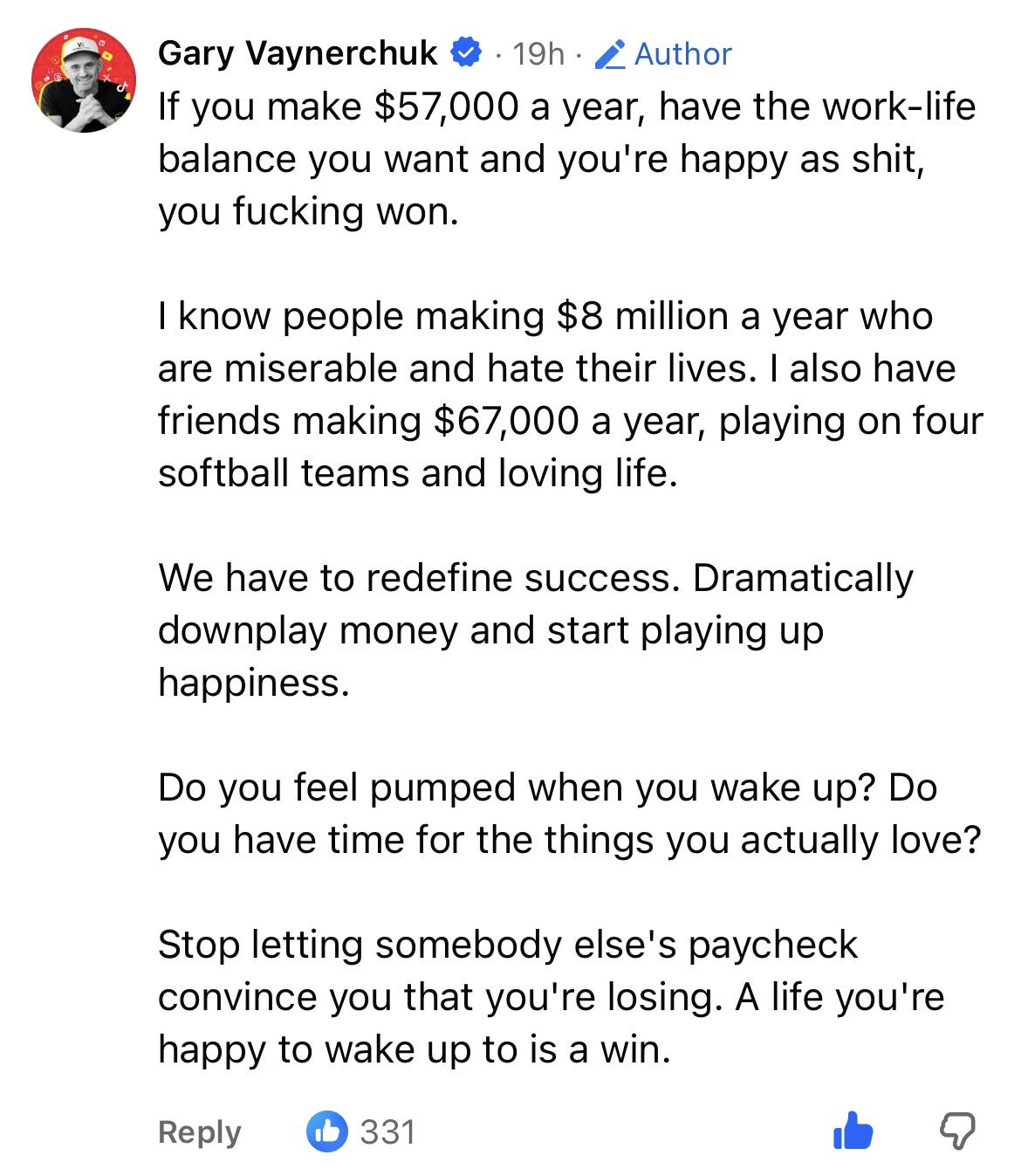
Earlier this week, Anton, a dad from Ireland, dropped this image into the Dadscord. And a thought entered my head, a collection of neurons that I’m fairly sure hasn’t fired in that unique combination before, that said: “Huh, Gary Vaynerchuk might be onto something there.”
Actual dollar amount notwithstanding, and acknowledging that $57,000 means something entirely different in a dense metropolis than a small town, I can say I have known both kinds of people in this picture. My circle of 8 million dollar dads is infinitesimally smaller than Gary Vee’s, but I’ve witnessed a similar pattern. I’ve worked for managers making 8 times my salary (which, for the record, is not and has never been remotely close to a milli) who were taking home pay packages that would make Manchester City directors blush, and were deeply unhappy people, especially outside of the large windows and bountiful beanbags of the office. I’ve known dads whose cost of living grew as rapidly as their salary, who painted themselves into a picture-perfect life—behind the wheel of a large automobile (on a monthly lease), in a beautiful house (with an eye-melting mortgage)—and who now wonder: well, how can I ever earn less than this?
Does money buy you happiness? A landmark 2010 study from Daniel Kahneman (yes, that one) and Angus Deaton (no, not that one) found that it does, up to a point, before flatlining at around $75,000 a year—$115,000 in today’s money. These findings were revised in 2023 when Kahneman discovered that happiness only plateaus for the unhappiest fifth of people, people named in the study as “financially well-off but unhappy.” Gary Vee’s millionaire mates, in other words. (I am reminded, as I often am in these moments, of Irish comedian Spike Milligan, who pleaded, “All I ask is the chance to prove that money can’t make me happy.”) The rest of us are running to stand still: in the year to August, US pay rose 3.7% while prices rose 3.4%—a real-terms raise of around $4 a week—while fuel across the EU is up 23.8%, and in the US is topping $4.40 a gallon.
The post, to our #tweets-and-memes channel, kicked off a conversation deeper than our dad meme thread has ever seen. Some dads agreed: “there are all types of wealth and some are far greater than others,” offered one, “I never feel richer than after a fun family day,” suggested another; others questioned the premise: “alright Gary, wire me a million dollars then” or “A little rich [no pun intended, from this dad, or maybe, given the vibe in the Dadscord, pun absolutely intended] that one of the big pushers of hustle culture is like ‘bro chill out.’”
The reality of the weight we carry as dads is omnipresent. Dads on the same salary for five years, waiting for a promised promotion while everything around them gets more expensive. Others holding tightly to jobs amid the ever-present threat of redundancy. These are not men chasing Montana; there is a world of difference between the dads who are seeking enough and the dads who can’t stop wanting more—and the trap Gary is describing, the one Call rides straight into, only opens once you have enough. So let’s not shed a tear for those millionaire dads! [woody-harrelson-wipes-eyes-with-bills.gif]. But let’s use their tales as warning signs. Ambition has driven them to where they are. But it keeps driving them forward, like Call, beyond a life that seems pretty idyllic to any onlooker.
In 2025, I wrote about the corruption of ambition, an early draft of what would later form a huge chunk of the book’s chapter on career, a piece that could have as easily been about Woodrow Call as any other antihero dad in the piece, dads who:
“Jump back on the hedonic treadmill, point another marker onto the horizon, and take a new definition of success that is just like the old one—everything will be fixed once we arrive here—a road that extends off into infinity, or until you die—whichever happens first.”
I spent years on that treadmill. It’s now been nearly a decade since I stepped off it, weaning myself off Big Tech’s sweet, juicy teat. In a good year, I earn a third of what I once did. In a bad year, it’s somewhere between a quarter and a fifth. (And let’s not talk about 2020, OK? We all agreed on that.) There are days when I wonder about the path not taken—the one where I decided to stay in the US, continuing to chase the version of the American Dream I’ve inherited, gulping down the Kool Aid—from both Google and capitalism-at-large—on that perilous journey for more.
But in the space of a few weeks, I got Lonesome Dove, an earnest Saul Goodman, a moment in the finale of The Office, and a Gary Vaynerchuk post shared in the Dadscord. That these four sources arrived in my life at roughly the same time was something I chose to notice and acknowledge here. They encouraged me to remember that—even on the toughest days—life is good: my kids are healthy, I live with a person I love, I have friends I like to hang out with, I do work I find fulfilling. I get to write for a group of great dads figuring these things out. (Sometimes, I get to work with them too.) I could have easily spent the last three thousand words, and twelve-and-change hours, making a list of all I am lacking and all the ways I feel hard done by. But I’d rather do this: a meditation on gratitude, and a love letter to a great book.
Buddhists believe that dukkha is not a permanent punishment, but a condition that can be understood and overcome. We must choose, every day, to move beyond our cravings for something better: gazing towards the horizon at the impossible prospect of a perfect life, whilst ignoring how pretty fucking great the one that sits before us is. If you take anything from this, accept it as an invitation for your brain to luxuriate in the always fleeting, possibly illusory, warm bath of an idea that we just might be living in the good old days we seek, and that one day we’ll look back on these moments as the best we ever had.
Signing off.
This email should be considered a personal recommendation of two of the following three things: Lonesome Dove, The Office and Gary Vee. I’ll let you decide which two.
This week’s essay was brought to you by the pressure of a self-imposed weekly deadline. How was it for you?