


Did I mention I have a book coming out? Of course I did.
We’re 34 days out from the US launch, and it’s taking up as much room in my head as my son’s La Liga futbol card collection is taking up in his. Last night he asked: “Instead of reading a book together before bed, could we go through my album, and I can show you my new shiny Barça cards?”
I mean, how can you possibly say no to that?
I wake up every morning and realise the publication date is another day closer. Sometimes, I don’t make it to 7 am, bolting upright in the middle of the night with a mental note to add another name to the outreach tracker. I’ve got a master list of over 150 “dream readers,” and am attempting to get the book in their hands before May 12th. Every day I work through as many as possible—on top of working on client projects, recording the audiobook, pitching op-eds and podcasts, and the never-ending list of parenting to-dos that clog up our inboxes, WhatsApp groups and mental plumbing.
On top of those 150, I started a bold (and some might say entirely stupid) endeavour to send a book to every living person in the index as a way to acknowledge the work on which mine is built. Some have been fairly easy to track down. Others—Daniel Day-Lewis, Kendrick Lamar, Haruki Murakami, Thom Yorke, to name a few—are proving much tougher.
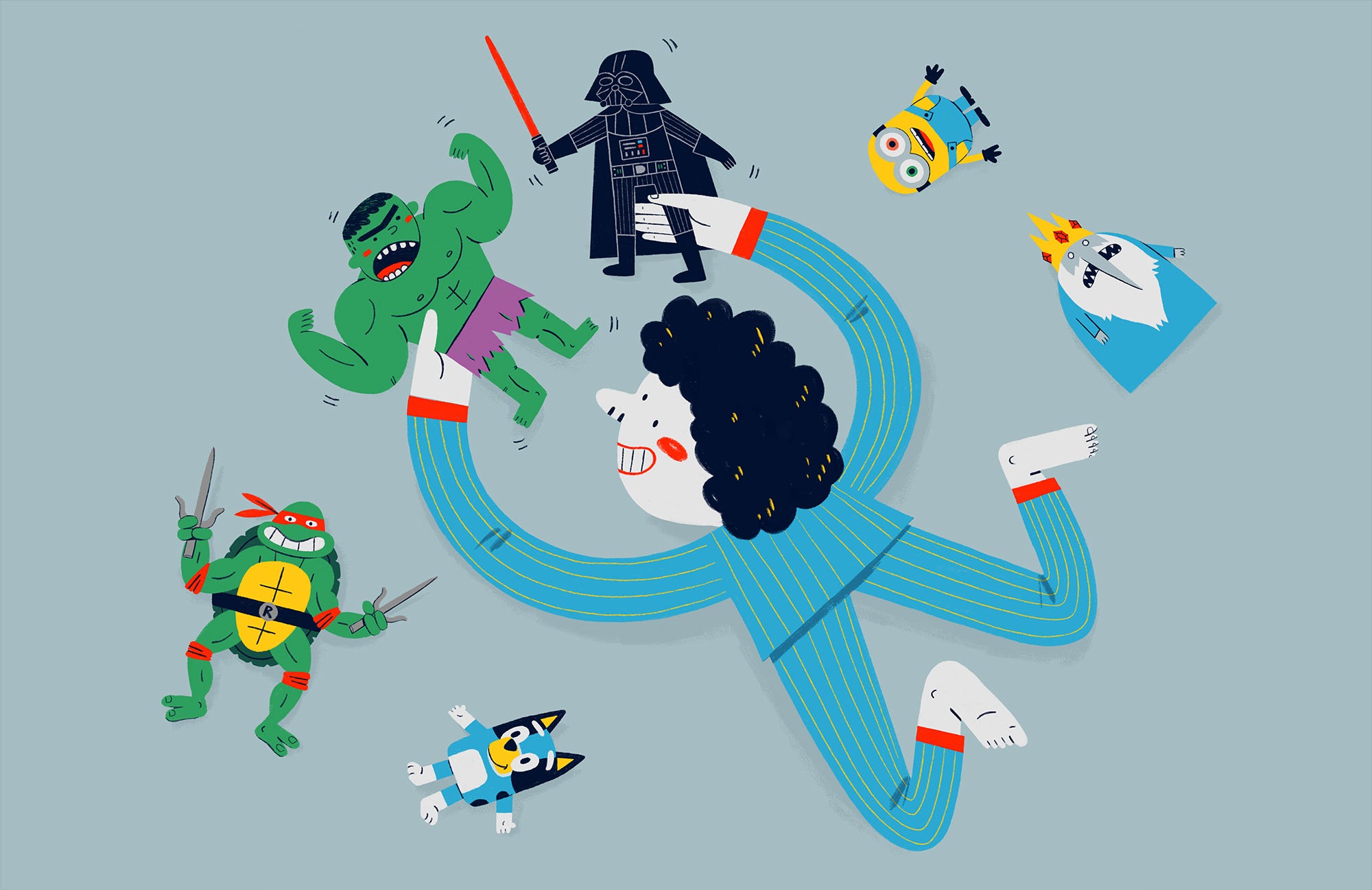
One side effect of this ruthless promo drive is that the headspace required for writing new newsletter essays is thin on the ground. So this week, I’m offering a rerun of this piece from 2023, which pairs with a stunning illustration from our ol’ friend Tony Johnson. I tried to get this one in the book, and was told by my publisher that we would almost certainly be sued for copyright infringement, possibly by three different media conglomerates. Hooray for the internet, eh?
Whilst you won’t see this one between the covers when your book arrives next month, you will see four gorgeous, full-bleed grayscale pieces from Tony, as we make our best collective attempt to channel The Wild Robot into a dad book.
I genuinely can’t wait for you all to get your hands on it.
“Am I a good boy?” my son asks, “Or am I a bad one?”
It feels like mere minutes ago the concept was alien to you. You’ll have known whether something was a good thing to do—finishing everything on your plate, saying thank you, or sleeping through the night. You knew some things were good, just as others were bad—hitting your sister, screaming when we turned off your favourite cartoon, or illicitly feeding the dog unwanted carrot sticks under the table. You later learned you could be good or bad at things you loved: how good you became at running, flying down the street as an ersatz Sonic the Hedgehog, accidentally executing a perfect Naruto run—arms straight back, chest towards the ground—without knowing it; or how good you became at puzzles, one of your recent obsessions, as the steam almost comes out of your ears and Beautiful Mind chalk lines form around you as you figure it out.
Are you good, little dude? It’s a hell of a question. Are any of us, truly? What does being good entail? And isn’t that what we’ll wrestle the rest of our lives? You’re asking it now for the first time; you might spend the rest of your life searching for the answer.
The pendulum of morality swings with abandon at this age. You’ve only recently started understanding these abstract concepts, but now these moral poles have been internalised and you’re crossing the Rubicon, moving from wondering “Is this good?” through to “Am I good at this?” to now questioning “Am I, myself, good or bad?”
My moral backbone was informed by an illustrated book of Bible stories, sitting nightly underneath my pillow, supplemented by a weekly homily from a man of the cloth. But as I’ve left my Catholic upbringing behind, rolling my own interpretation of spirituality, I’m less comfortable outsourcing my children’s moral teachings to the Good Book. Morality and religion have always been bedfellows, playing supporting roles in society from day one. Adam and Eve were banished from paradise for unbecoming behaviour: eating the forbidden fruit after being repeatedly told by God to leave it well alone (a tale familiar to all parents). The Egyptians believed that, upon death, Anubis would place your heart on one side of a scale and a feather upon the other. If your heart was lighter—indicating you’d spent your life avoiding sin and accomplishing good deeds—you were welcome to join them in the afterlife for eternity. If your heart tipped the scale in its direction, you’d be sent to the underworld, or eaten on the spot by the lion-hippo-crocodile hybrid goddess Ammit. Christians may be nodding their heads after growing up with an adjacent concept (minus the getting eaten part) with the reckoner St. Peter, and his book of awaiting deeds as you approach the pearly gates of heaven.
My son takes some lessons from a religion that is not my own, learning stories of the Hindu deities passed down through his mother’s side. But where Christian morals are imparted through original sin and its seven deadly cousins, biblical tales and plagues, and the threat of eternal damnation (at least in the Irish Catholic strain that informed the early formation of my own moral compass), Eastern religions like Hinduism, Buddhism and Sikhism focus on living a life in accordance to Dharma: a moral code that offers ways to live a better life. (Dharma is intricately connected to the more widely known Karma—the law of cause and effect through living a life aligned with, or contradicting, Dharma’s principles.)
The ongoing acts of violence in the world remind us of the dangers of applying binary labels of “good” and “bad” to vast swathes of the population. But children yearn for simplicity and situations where things sit on one side of the other. That’s maybe why my son has fallen so deep into rabbit holes of space battles and superheroes. (Perhaps I’m confusing causation and correlation, which wouldn’t be the first time. Apparently, 100% of the people who confuse correlation with causation end up dead.) The ongoing escapades of Disney and its subsidiary companies—the highs and lows of Pixar, the MCU and Star Wars—illuminate his early understanding of complex principles like virtue, ethics and justice. Inside Out brought his emotions to life and helped him understand when his “red guy” was at the controls. The Incredible Hulk is good, but he’s angry—a complex one to parse, his young mind still unable to grasp the idea of the chaotic good alignment. And he hasn’t yet wrapped his head around why the Darth Vader toy we picked up from eBay has Anakin Skywalker under the mask. “But Anakin’s a good guy, right?”
If only it were so clear-cut. But life isn’t that neat. The truth is more complex than the stories we tell ourselves, and the answers we find aren’t easy. Like many, I’ve done my fair share of bad things, and there are moments in my life I’m not proud of. But I’m not the type to find myself asking whether I’ve been bad—that’s not what keeps me awake at night. (“Have you been good enough?” is more likely to have me thrashing into my pillow at 3 am.) In parenting, as in life, morality and discipline are intertwined. Morality influences behaviour. Bad behaviour begets punishment. And whilst discipline today is less severe than what we experienced in our own childhood years—what I would have given for a naughty step to time out on back in the 80s—it can still illuminate the gap between bad and good (or, more accurately, between bad and very bad) for our children.
Whenever the concepts of reward and punishment arise, the carrot-and-stick metaphor remains top of mind. I tend to think of my parenting approach as more orange-tinged—especially when said carrots are offered in Haribo form. But I grew up in a stick-first household, as many in my generation did, and did even more in the generation before. When my mum was little, my grandmother would send a misbehaving child outside to obtain the object of their own demise. She’d return from the back garden with a sally rod—a stick broken off the substantial branches of a nearby willow tree. If she picked a thin stick, my Granny would head outside on her own, searching for a heftier instrument, gifted double the thrashing on her return.
Visible marks fade quickly. Invisible ones—the ones that don’t trouble teachers, other parents, and friends—are harder to shift. Invisible to the eye, they take root inside and burrow underneath, creating inverted scars that define future selves. The lines of morality change over the years—what was acceptable then isn’t acceptable now, if it ever was. But if writer Peggy O’Mara is correct, and “the way we talk to our children becomes their inner voice,” then the way we define morals to our children will form their internal compass, and the way we discipline them will become their inner critic. It’s a sad truth that no one is harder on you than you are on yourself. Children who internalise judgements at an early age will end up spending vast amounts of time (and therapist fees) trying to shake them off as adults.
So, back to where we began. What do I want my son to believe? I want him to know: you are not bad. Sometimes, you do bad things, but that’s OK. You’re a work in progress, just like your old man. Other times, and (mercifully) more often, you do good. What’s important is you’re beginning to understand the difference. If you spend your life chalking up marks in the negative column, you’ll find folks don’t want to be your friend, and life will be more challenging. But if you try your hardest to do good and to be good—considering the feelings of others, being there for your family and friends, and treating others as you’d like to be treated—that’s all you need to worry about for now.
Good Dadvice
Say Hello
Back to the emails, I suppose!? How was this for you?
Loved | Great | OK | Meh | Bad
Branding by Selman Design. Illustration by Tony Johnson. Survey by Sprig.