


The book is now out everywhere! It’s been wonderful to see the response from dads around the world, sharing their favourite passages online, emails coming in from far and wide, reviews from folks who clearly get what the book is trying to do, and why it’s so necessary.
One hiccup last week was an influx of messages from dads outside the US, asking why the online stores were showing delivery times in July. After a little digging around, it turns out the initial run of books sent outside the US has sold out! My publisher is working on a re-up, and the books are making their way across the Atlantic as we speak. So if you’ve ordered a copy and received a delay notice, or are looking to get one before Father’s Day, don’t worry. Any orders placed will put you at the front of the line for the next drop. Get it while stocks last, I guess?!
After a sold-out event in London last night, I’ll be in Manchester next Tuesday, June 2nd, the next leg of the tour. Homecoming date. Hope to see some of you there.
The idea of my kids not playing videogames was always a non-starter.
Our house is stacked with consoles, the closed TV cabinet door hiding all manner of oblongs emblazoned with a trio of logos: Nintendo, Microsoft, Sony. And those are just the ones in active circulation. There’s a cardboard box in the bottom of a cupboard filled with the dusty remains of those who came before, ancestors who paved the way: an imported Japanese GameCube, delivered after Santa’s last hurrah; a Nintendo 64 with a copy of Goldeneye seemingly sealed into the cartridge slot; a Dreamcast, sadly left us way too young. When we moved to the US, and were only granted 500kg in shipped goods (which seems like a lot, until you realise it’s only twenty 25kg suitcases), we were faced with the difficult decision of deciding whose yellowing Super Nintendo we would keep—mine or my wife’s—before selling the other.
During my own childhood, videogames were an escape, a world to fall into whilst hidden away in my bedroom, my parents confused as to why I was spending so much time jumping through green pipes and eating reality-shifting mushrooms. (One of those things I’d end up doing a lot more as a fully-functioning adult).
But with my kids, it became a bonding ritual and a passing of the torch. During the COVID-19 pandemic, Spain entered a period of lockdown that we were sure would end soon, naive and utterly oblivious to the 42 days we’d spend in the house with a five-year-old and one-year-old, their exit from the front door deemed an illegal act. It was during this time that Nintendo released Animal Crossing: New Horizons. It was, as Keza Macdonald writes in the fabulous book Super Nintendo: The Game-Changing Company That Unlocked the Power of Play, a game that “offered community, creativity, relaxation and connection to a world that was suddenly starved of all those things.”
Japanese videogame designer Katsuya Eguchi was the mastermind behind the game, and created it with his own children in mind, after his job as a producer and director for Nintendo, working on classic games like Super Mario Bros 3, Super Mario World and Star Fox, meant missing time spent with his children at home. As Simon Parkin wrote in the New Yorker, covering the game in March 2020:
Eguchi joined Nintendo, in 1986, at the age of twenty-one and found himself alone, in a new city, severed from friends and family. Even as he climbed the company ladder, he routinely had to work past his children’s bedtime. Animal Crossing was his response: a game in which people, playing at different times, could bond in unprecedented ways. Eguchi could finally spend time with his children.
This game would bring my daughter and me together, fulfilling Eguchi’s vision. We’d spend the endless pandemic days working on our island, visiting friends across the world who were also doing the same. It would become our first foray into a shared digital world. But it wouldn’t be our last.
For the last year, I’ve been getting up every Saturday and Sunday to work a weekend job.
I’ll head to the kitchen, pour myself a glass of water and walk into the living room. I’ll check with the kids if they’ve eaten breakfast—fun fact, parents with younger children, at one point in your future, your offspring will start making their own breakfast on the weekends while you stay in bed, often, but not consistently—and my daughter will ask me, “Are you ready?”
And we’ll pull on our pixel overalls and clock in for a shift on the farm.
I turned my daughter onto Stardew Valley a few weeks shy of her 10th birthday. Released in 2016, the game is, at its most simple, a farming simulator: you begin having left a stressful city job behind, taking up residence on a dilapidated farm you’ve inherited from your recently passed grandfather. You start with a crummy set of tools: a pickaxe, a hoe, an axe, a scythe and a watering can, and are given very little instruction. The first task at hand is simply cleaning up the mess that you were left: unruly hedges left to run riot, stubborn tree stumps that won’t respond to your puny axe, trash-filled ponds unable to sustain life. You head to the local store, buy some seeds, and grow your first crops. You pick up a fishing rod and understand the hidden value beneath sea level. And, as you make your way around the village and get to know its local inhabitants, the game gently introduces you to its many delights.
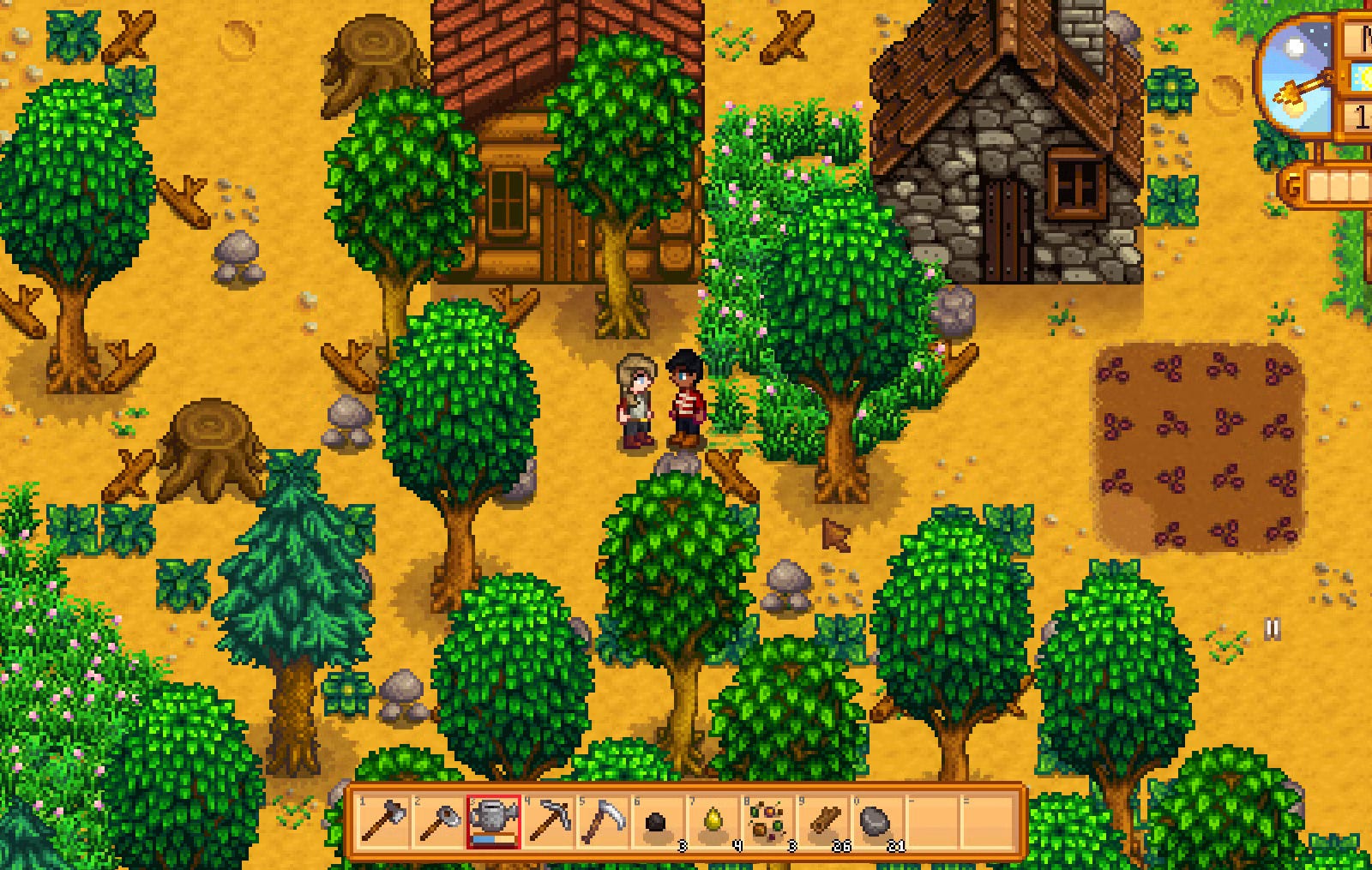
Padme had been playing the game for two in-game years (cigarette packet maths: 15 real minutes per in-game day x 28 days per in-game month x 4 months per in-game year = 56 real-life hours) with her dad watching on the sidelines. I’d offer tips: had she thought about putting mayonnaise makers in her coop, since processed mayo would sell for more than the eggs the chickens lay every day? And with the cows, cheese presses would be a good way to turn that milk into pure profit. “But those things cost money,” she’d reply. “Yes,” I’d retort, “But here’s a lesson about the world: you have to spend money to make money. If you invest in something today and it starts making money, soon your initial outlay will turn into profit, and those things will start to add up.”
She hated seeing the gold counter that indicated her farm’s net worth in decline. All that hard work she’d done! But the solution was right in front of us. The game’s solo developer, ConcernedApe, hand-crafted every single part of the world: designed the pixel art villagers, wrote the dialogue for every character, programmed the seasons and the weather cycles, and even composed the soundtrack, still listened to by almost half a million people on Spotify every month. Over the last decade, he has continued to ship updates to the game, and Version 1.3, released two years after launch, added the most requested feature: multiplayer. Now, additional houses could be built onto the farm, and the joys of local co-op were unlocked. Dad would start mucking in and mucking out.
A quick multiplayer refresh, for those at the back: once upon a time, there was only one way to play videogames with each other—co-located, side-by-side, shoulder-to-shoulder. Whether stood in front of an arcade cabinet giving your best HADOUKEN, or sat cross-legged in front of a CRT television trying to pop your siblings’ balloons in Super Mario Kart, we played together. Later, with the advent of the internet, multiplayer moved online, as games like Quake, Counterstrike and Unreal Tournament required lightning reactions to nail that perfect headshot; whilst fortune favours the brave, these games favoured those in the US with T1 connections and low ping rates that my humble 56k dial-up modem could never.
My kids are allowed one hour videogames on Saturday, and one hour on Sunday, and I won’t ever be telling them the screen time rules—or lack of them—that I grew up with, so quiet in the back. Whilst we’d play the game for only two hours a week, the mental grip it held on us extended far beyond those boundaries. We went in deep, watching YouTube videos on how to optimise farm layouts, strategies for besting the Skull Cavern, and how to find and grow the mythical ancient fruit. It was a core topic of conversation, and became more than a game—it was an opportunity to talk about how the world works: the golden loop of hard work, saving and investment, the importance of planning your time, how to choose what to focus on, and accept things that are out of your control. And, over time, I’d begin to learn as much from her playstyle as she would from mine.
Whilst I was ruthlessly focused on profit, her time spent in the village was spent on building the relationship meter with the game’s 28 villagers, researching and gifting their favourite items, running fetch quests for them in order to unlock more “heart events,” unlocking the mysteries of the game—the quiet, brooding man who is revealed to be struggling with alcoholism, the woman desperate to follow her dreams of becoming an artist, but still working to build back her confidence after a long-term relationship with an unsupportive spouse.
In this time of modern masculinity and awakened definitions of fatherhood, I’m not sure “my dad could beat up your dad” carries the same weight in the playground as it once did. But “My dad could destroy your dad in Super Smash Bros. Ultimate” has a fairly good ring to it. Our children offer a limitless well of hobbies, old and new: whether it’s using your daughter as an excuse to learn how to play the piano, or spending a Sunday morning watching your son swap football cards whilst you practice your Spanish with local dads. Abundant Fatherhood means attuning your senses to the many ways our children can be an excuse to find joy and improve our lives.
The net worth of Paradise Farm recently crossed 2 million gold coins. Passive income has been achieved, my watch has ended, and I have hung up my overalls. I will soon swap them for a black cowl and cape and venture into a fake plastic Gotham City with my son for Lego Batman: Legacy of the Dark Knight. In my stead, my wife has taken up the mantle of farm hand, starting afresh with my daughter on an entirely new farm, nary a penny to her name. They’re saving up for a horse stable. My daughter wanted to invest in agricultural infrastructure. My wife pushed back that they needed the money for the horse.
“Mum,” she offered, “You have to spend money to make money.”
Before looking over at her smiling father, and rolling her eyes at the accidental assimilation of another life lesson.
3 things to read this week
I’ve been out and about promoting the book! Here are a few things you might enjoy.
“The New Fatherhood: You Either Sort It Out or Pass It On ” by Dr Becky on Good Inside. I talk with Dr Becky Kennedy about the emotional transformation happening inside modern fatherhood, and the work modern dads are doing to parent differently than we were parented ourselves. (Podcast link, if you’d prefer to listen than watch)
“7 Expert Habits to Make You a Better Dad” by Lynda Lin Grigsby in GQ Magazine. Whilst my dream of being a GQ cover star will have to wait a little longer, it was fun to share some of the tools and techniques I’ve developed in over a decade of parenting in their Expert Habits column, written up by Lynda Lin Grigsby, a long-time reader of the newsletter.
“The New Fatherhood” on Chicago’s WGN 9 Midday News. In my live TV debut, I spoke with Patrick Elwood from WGN 9 Midday News in Chicago, and managed to get through the whole thing without shouting “CHI CITY!” which I’m particularly proud of.
Good Dadvice

Say Hello
How did you like this week’s issue?
The part that got me: you set out to teach Padme "spend money to make money," and she handed back a completely different lesson. You were running the gold counter; she was building the relationship meter with you. And I have been the mayonnaise-maker dad too, optimizing the coop while my kid quietly out-attended me in the one room I wasn't watching. Maybe Abundant Fatherhood is partly that, noticing, a couple of in-game years later, that your kid was the better player all along.