


I’m writing this from a coffee shop in Brooklyn on the morning of May 12th. The book is now on sale in the US, and you can buy it here. If you’re outside the US and audiobooks are more your jam, then you’re in for a treat: I narrated it myself, and it’s available worldwide on Audible, Apple and Spotify.
If this newsletter has provided you with support, joy, or a sense of being seen over the years I’ve been writing it, please go grab the book. I am so proud of it, and so unbelievably excited for you to read it.
For the last two years, there’s one question I’ve heard more often than others.
“How are you?” Nope.
“How is the family?” Not that, either.
“So, how’s the book going?” Friends, family, well-wishers. All would ask. Incessantly. On a good day, I’d smile and change the subject. On others, the question was enough to send a shiver down my spine. It would regularly wake me up at 2 am in a cold sweat. How was it going? It was an undertaking unlike anything I’d ever attempted. The difference between writing a book and writing a newsletter was like the difference between raising a kid and raising a cat.
Fun fact: the time between signing the contract to write the book until the day I delivered the initial manuscript was nine months. The most poetic gestation period. I couldn’t have asked for better. The first trimester was chill: background reading, chapter outlining, trying to figure out the arc of the story I wanted to tell. The second trimester, things ramped up—a bout of writer’s block saw very little movement for weeks, until I remembered a line by the French auteur Jean-Luc Godard who said: “A story should have a beginning, a middle, and an end... but not necessarily in that order.” I started writing in the middle, and fought my way out in the only way my ADHD-riddled brain would allow: by focusing on the shiny bits. Chapters that I was writing because I felt “I had to” were cast to the side. All killer. No filler.
The third trimester was—as it is for so many dads—when shit got real. I’d spend parts of the day running the mental gymnastics required to convince myself I could turn out 80,000 words in the required time: calculating the remaining words to get there, divided by working days I had left, minus the day a week I’d spend on the newsletter, minus bouts of sickness (my own and my kids) and whatever battle would be thrown my way that week.
When that initial manuscript was handed over—May 4th, 2025—I exhaled. For a few months, it was no longer my problem. Until it boomeranged back with edit suggestions from my publisher, agent, and two good friends, Aaron and Justin. There were two consistent “themes” in the comments. The first was what I termed “George Bernard Shaw” problems, based on the Irish playwright’s wry observation that the UK and US were “two countries separated by the same language.” What the hell is a space hopper? What are wellies? And shouldn’t there be more Zs in all of these words?
The other comment was about references. If you’ve been reading this newsletter for a while, you know I always bring the receipts: the peer-reviewed papers and sources I link to liberally. “You’ll need a lot of citations in this book,” my editor warned. I wasn’t worried—I’d been hyperlinking everything as I went. How hard could it be? How wrong I was. The Chicago style guidelines that came back required page number, publication year, and edition for every book. So many of my sources were Kindle highlights or quotes I’d picked up over years of internet travels. I decided to triple-fact-check everything and only cite original sources wherever I could, which meant hunting down the research papers that publications like Psychology Today, NPR or The Atlantic had cited. And with painful regularity, I’d find the data in the paper and the interpretation in the article didn’t quite line up. Meaning even more rewrites were required.
Was it tough? Oh yes. The book only got better as a result. But those last few weeks nearly finished me. The lowest moment came last summer, when my role as a writer came into direct conflict with my role as a dad. It was August, and if you’ve ever set foot in Spain or Italy during the height of summer, you’ll know one thing: it’s hot. Life on the Mediterranean means most locals will shut up shop and get out of the city to escape the unbearable heat. My rewrites dropped right in the middle of this period where, after an intense year, we’d booked a HomeExchange for a week of downtime: a small apartment an hour outside of the city, with a shared pool for the kids. The amount of work required for the rewrite meant I’d spent that week hidden out in the loft of our temporary habitat, air conditioning only a dream, a fan slowly rotating, blasting some sweet relief my way. I could hear the kids fighting downstairs, and who could blame them? We’d come out here to have fun, and I was stuck with my head in my laptop, shouting at them to leave me alone so I could sit and write a book about being a better dad. I began to realise how Jack Torrance felt at the Overlook Hotel, chained to his typewriter and losing his mind while his wife and son watched his sanity slowly slip away.
259 endnotes later, I was done. Of course, there was still more work to be done: every time I thought I was out, they pulled me back in. But then came the cutoff, and no more changes could be made. For the last few months, I’ve been existing in what artists always refer to as a liminal space, or what a parent might call nap time—that quiet moment between certainty and uncertainty, an acceptance that my work writing this book is done.
In 2013, British actor and director Marcus Romer took to Twitter to share the six stages of the creative process:
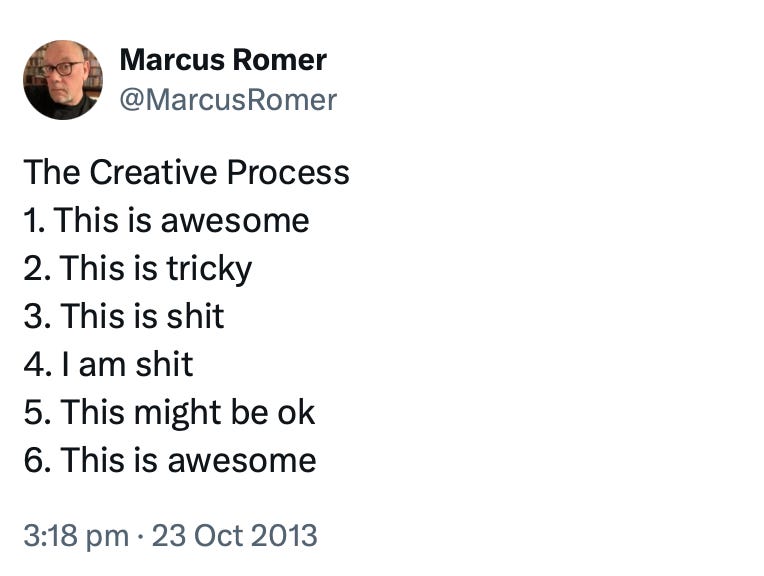
It’s been three years since I started working on this book. And after going through the exact process Romer outlined—and spending a lonnnnnnnng time at point 4—I now have enough space that not only do I like this book, I truly love it. For the last few weeks, with copies spread across the house, I’d find myself opening it to a random page, and treating it like I would any other book (or more accurately, every other book) I haven’t written. And breaking out in a smile.
“How’s the book going?”
Now, finally, you can find out for yourself.
—-
Written by me, and hundreds of you
Warning: This is not a book for new dads. Or, not just for them. I wanted to write the book that I wish someone had handed me at any point over the last twelve years, as I was piecing all of this together on my own. A book that would become an essential resource for any dad, whether your firstborn was on the way or you just had a door slammed in your face by an angsty teenager. The book you would buy for a friend, brother or colleague, who was struggling in The Tunnel with three kids under five. Based on feedback from early readers, I'm confident I got there, and I’ve written a book that dads can learn from and turn to throughout every stage of fatherhood. Searching Google last week, I saw that the algorithms had categorised it as a “self-help book.” And, you know what? They’re not wrong. No one is coming to save the dads. Who is going to help us, if not ourselves?
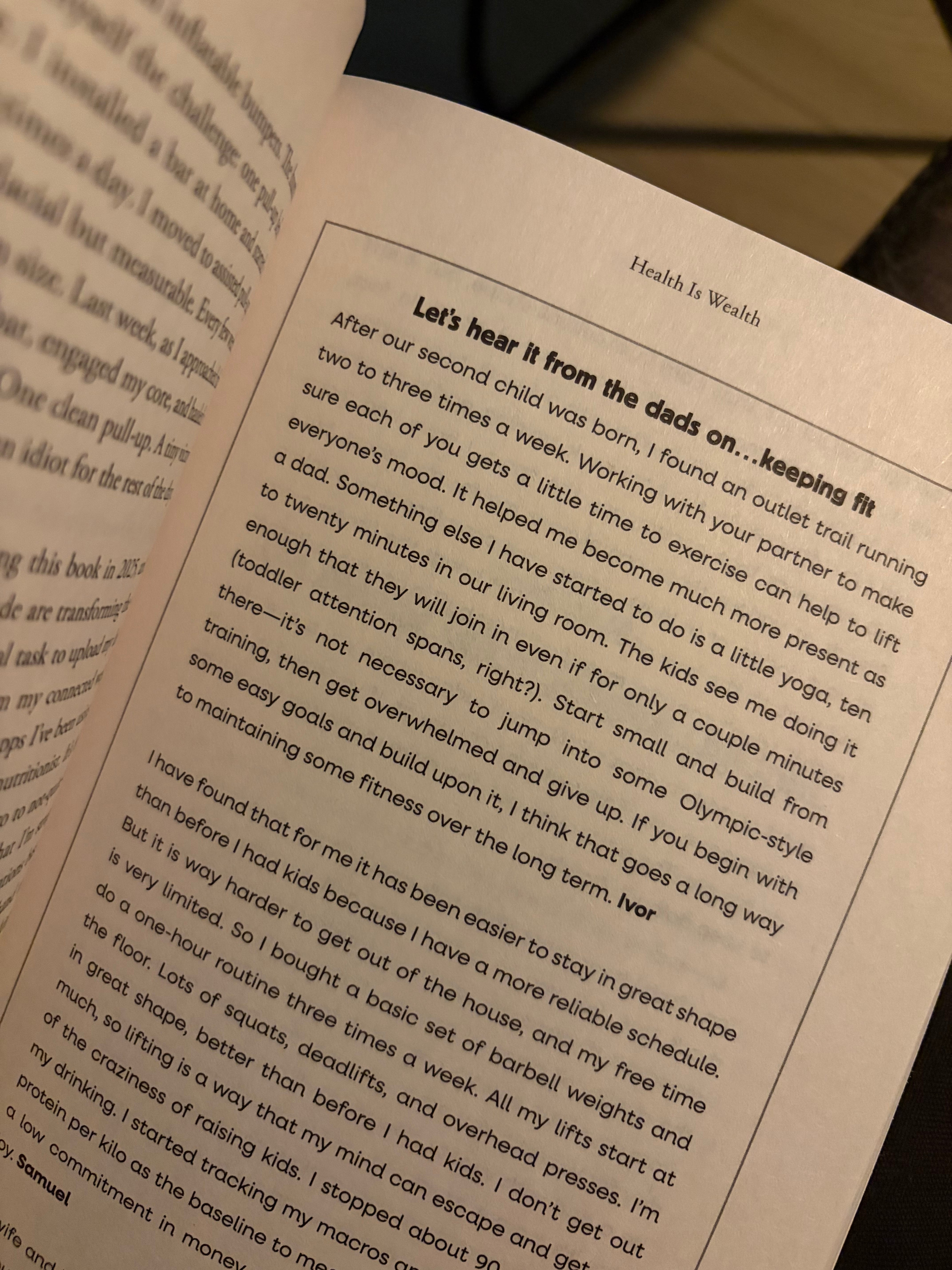
Core to the DNA of this newsletter has been that The New Fatherhood is being driven forward by all of us—every dad who pushes back against the narratives he inherited unwillingly and who works hard to forge fatherhood in his own terms. Though my name is on the cover, I didn’t write this book on my own—it has been shepherded into existence by so many of you: the dads who jumped into open comment threads in the early days of the newsletter, the ongoing conversations we have in the Dadscord every day, all the ways those in the orbit of this newsletter continue to show up for each other. So, in keeping with how we do things in the newsletter, every chapter ends with a “let’s hear it from the dads” section, in which I hand the megaphone over to some of the most powerful things I’ve heard from the thousands of dads who have been reading the weekly newsletter over the last five years. You might even find yourself in there.
The Wild Dadbot
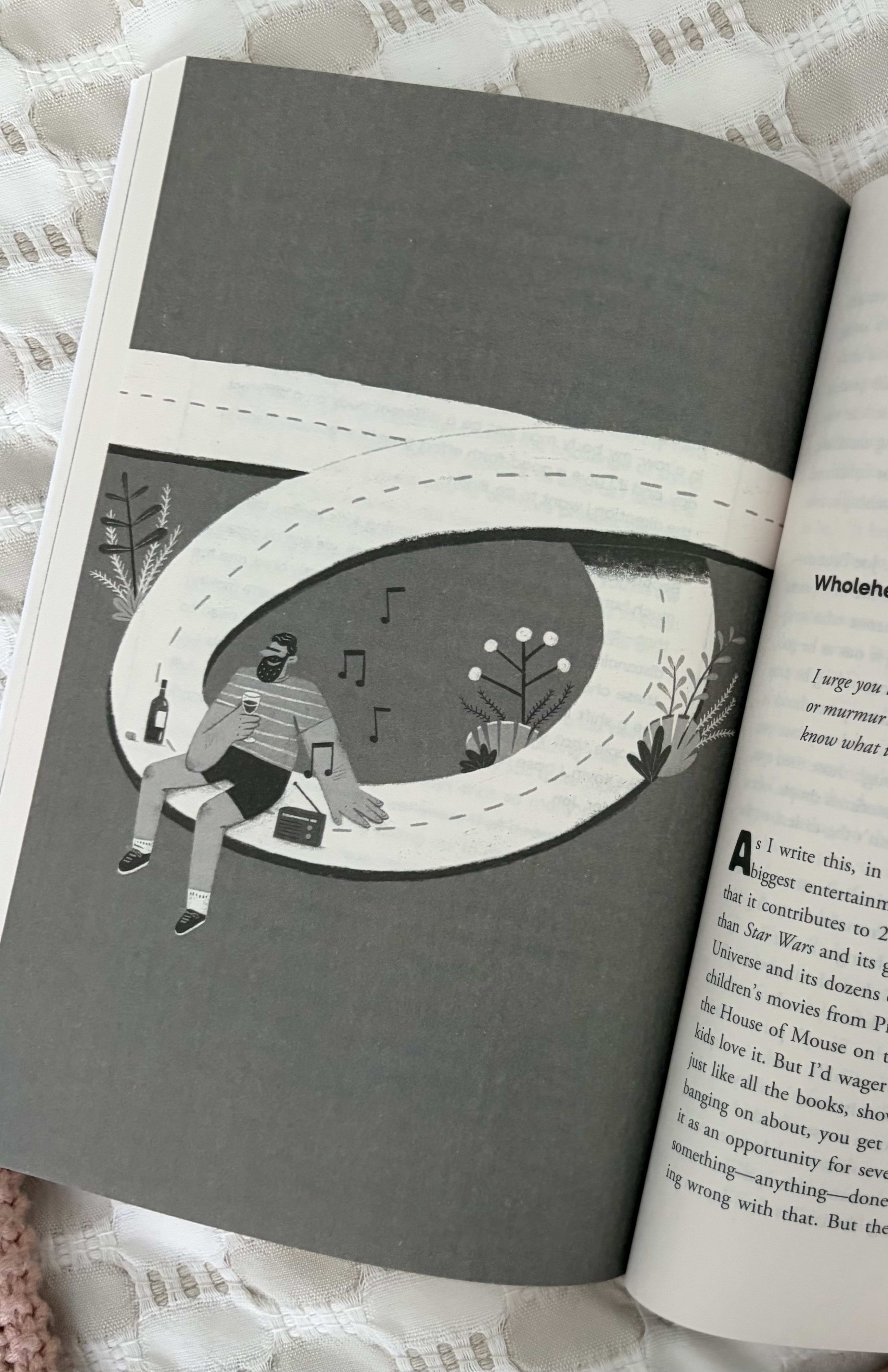
In addition to the spectacular cover by Selman Design that you’ve all seen, the final copies that arrived also feature beautiful illustrations inside. When I first started talking to Tony Johnson about adapting some of his newsletter work for the print edition, I shared my love of The Wild Robot book, with its monochrome illustrations throughout. After initially pushing back on the idea of an illustration for each chapter—great decision, Tony—we settled on four illustrations, one of each act of the book and a final one for the epilogue. To say these came out well is an understatement; they have to be seen to be fully appreciated.
That’s enough for now. I’ll stop banging on about the book for a while, so long as you go buy it. Thank you for reading, and for being part of this.
Congratulations! I have just started the audiobook. The image of you sweating in a Spanish loft, shouting at your kids to leave you alone so you could finish a book about being a better dad, I relate to that so much with my own work. The contradiction doesn't resolve neatly, does it? I think that tension is actually the book's best credential. Only someone who lived that irony fully could write honestly about it. Congratulations on getting it out the door. The 259 endnotes alone are an act of service.
Congratulations, Kevin – a monumental achievement! As an editor I'm forever passing work back to authors without perhaps appreciating the time and energy that demands of them – reading this article renewed my appreciation for those patient authors like you who give up so much to do the real work. Plus, I can't wait to read TNF when it drops in the UK!