


When times are hard, I reach for my dog-eared copy of Pema Chödrön’s When Things Fall Apart: Heart Advice for Difficult Times. This book continues to provide support during times of turmoil, those days and weeks when the waves feel like they’re crashing uncontrollably upon the boat. This week’s newsletter is a light update to a 2021 essay about the book. I hope that Chödrön’s words can provide others with the same strength they continue to give me.
No one had an easy pandemic. Here in Spain, we endured a 42-day lockdown during which our two children were completely forbidden from leaving the house. Not to go out for a walk, not to visit the shops. Nothing. Nada.
People were talking at the time about the inevitable baby boom nine months later. I joked it would be made entirely of first-born babies: no one in their right mind would have shown a desire—during a time of coronavirus, captivity and confusion—to throw an extra child into the mix.
In May of 2020, halfway through our confinement, my wife shared an episode of a podcast she thought I’d like: Devendra Banhart (a musician I adored, big tick) was talking about a book he’d found helpful during the pandemic (bigger tick) that was a modern reframing of old Buddhist teachings (OK, sold).
This was to be the first episode of On Being that would grace my ears. Long-time readers will know how important these series of intimate conversations between host Krista Tippett and her hand-picked cadre of spiritual warriors would become. Devendra and Krista shared their favourite passages from When Things Fall Apart, a book by Pema Chödrön about finding strength during times of chaos. My son hadn't been sleeping well at the time. I listened horizontal on a rollout mattress on his floor, rubbing his back while he slept in his cot at the end of the crazy day. He was nodding off to sleep; I was far from it. The podcast had me hooked. I rewound repeatedly so as not to miss a beat.
Awakening is frequently described as a journey to the top of a mountain. We leave our attachments and our worldliness behind and slowly make our way to the top. The only problem with this metaphor is that we leave all the others behind—our drunken brother, our schizophrenic sister, our tormented animals and friends. Their suffering continues, unrelieved by our personal escape. In the process of discovering "bodhichitta" (a noble or awakened heart), the journey goes down, not up. Instead of transcending the suffering of all creatures, we move toward the turbulence and doubt. We jump into it. We slide into it. We tiptoe into it. At our own pace, without speed or aggression, we move down and down and down. With us move millions of others, our companions in awakening from fear. At the bottom we discover water. Right down there in the thick of things, we discover the love that will not die.
— Pema Chödrön, When Things Fall Apart
We remain a society obsessed with individual achievement. We equate success with elevation: “Climbing the ladder”, “Scaling my Everest”, “Being on top of the world”. Fatherhood is changing you. But if you step back, you’ll see it's changing all of us together. What might happen to a group of dads who realise they could help change each other? What if true fulfilment could be found not by ascending heights alone but by moving to deeper places with others?
I See A Darkness
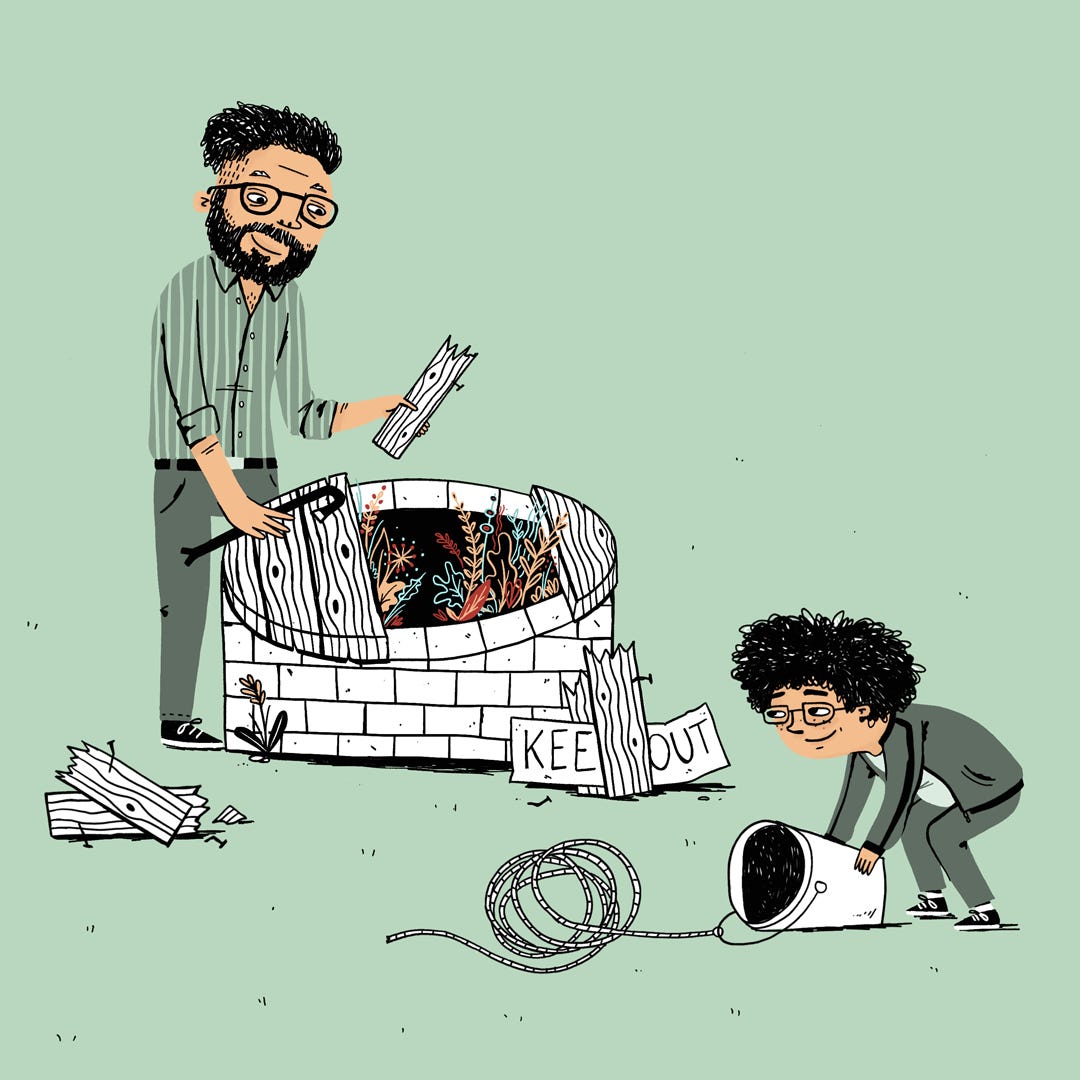
For generations gone by, boys have been introduced to The Well of Feelings at an early age. “It’s dangerous,” they’re told. “Don’t look down there. Don't get emotional. Stop crying. Man up.” They come to equate the well with darkness and fear. They learn to stay away from it. They hammer a warning sign nearby: DANGER. STAY OUT. They nail it closed with old wooden planks, to be avoided it at all costs. And then they grow older. Their fear of what might be in there solidifies. Maybe they saw other boys get bullied for playing near it: playing with a doll, talking about their feelings, crying in the playground, acting “like a girl.”
Decades later, you find yourself with a child of your own. Back to the well you go, face-to-face with your feelings after all this time. It’s unavoidable: these tiny humans pull you towards the darkness as you wonder what was down there all along, carefully prying nails out of old boards that kept you out—or that kept something else in. And then you realise it might not be so scary after all. In fact, it’s rather beautiful ...
Into it disappeared plot and space, what was left was emotion, and it was stark, you were looking straight into the essence of human existence, the very nucleus of life, and thus you found yourself in a place where it no longer mattered what was actually happening.
— Karl Ove Knausgaard, A Man in Love.
We're conditioned to look at fatherhood as something that has to compete with our career and passions. Choose success in your job or choose to be a great dad. Either/or. Because you can’t have both. If you want to climb the ladder, there will be late nights, early mornings, missed bedtimes and busy weekends. Even at Google—supposedly one of the most forward-thinking companies for working parents—I was pulled aside by a manager and chastised for “leaving early too often" to be home for my newborn daughter’s bath time. We’re force-fed success stories of childless men who get up at 5 am to do an hour of emails, 45 minutes of Wim Hof breathwork and then 90 minutes pedalling the Peloton. And if you’ve got kids? Forget about it. Therefore, forget about success. It’s over.
So fatherhood begins to feel like a weakness. A loss of your killer edge. Something that brings you further from “the top.” (Again with the elevation!) But the Well of Feelings changes all of that. Because when you head down there, it doesn't take away. It's additive. As you go deeper down the well, you learn what lies underneath. You conquer the fear you had and the hold it had over you. You learn more about yourself than you've ever known. It's a real Bruce Wayne moment when you finally reach the bottom. Because it's not a well; there’s a whole Batcave down there—a subterranean HQ filled with tools to bring new perspectives to every aspect of your life. Empathy. Tenderness. Emotion. New abilities to funnel back into your career and interests: how you create, how you communicate, how you listen, how you understand. Your ability to connect with others becomes your superpower.
And the struggles you face? They are what will provide you with your strength. As Chödrön writes: “Only to the extent that we expose ourselves over and over to annihilation can that which is indestructible be found in us.”
The father of a two-year-old talks about turning on the television and unexpectedly seeing the bombing of the federal building in Oklahoma City. He watched as the firemen carried the limp and bloody bodies of toddlers from the ruins of the day-care center on the building’s first floor. He says that in the past he was able to distance himself from other people’s suffering. But since he’s become a father, things have changed. He feels as if each of those children were his child. He feels the grief of all the parents as his own grief. This kinship with the suffering of others, this inability to continue to regard it from afar, is the discovery of our soft spot, the discovery of bodhichitta, the Sanskrit word that means “noble or awakened heart.”
— Pema Chödrön, When Things Fall Apart
When listening to the podcast and reading the book (two experiences that, if it isn't blazingly obvious by now, I highly recommend), I am reminded that Bodhi, my son's name, means “enlightenment.” I can see a direct line that runs from my experience in learning to love him to writing this newsletter today. Chödrön’s writing helped me truly understand Hemingway’s observation that “The world breaks everyone and afterward many are strong at the broken places.” Having a son pulled me into the well in a way that having a daughter never did, making me realise the avalanche of work to undertake to ensure he wasn’t afraid of what lies within, and to learn to meet it head-on.
This very moment is the perfect teacher, and it’s always with us […] We can be with what’s happening and not dissociate. Awakeness is found in our pleasure and our pain, our confusion and our wisdom, available in each moment of our weird, unfathomable, ordinary everyday lives.
— Pema Chödrön, When Things Fall Apart
Say Hello
Got a book that you lean on when times get tough? Please share it with all of us in the comments, or click here if you’d rather share it privately.
How did you like this week’s issue? Your feedback helps me make this great.
Loved | Great | OK | Meh | Bad
Branding by Selman Design. Illustration by Tony Johnson. Survey by Sprig. I made it all the way through without making a Timmy O'Toole joke. Even I’m surprised.
Every time brother. I love you. I love your intellect, emotional range and humour. You’re able to cut to the core without preaching or giving the illusion of having answers. Just a beautiful, compassionate shared perspective on how we can navigate these ever shifting seasons of our lives. Always impeccably timed too.
Been in the realms of feeling shifting energies of life, mood more sombre, stoical, humble. Noticing my energy drop physically, while I turn inwards and find the anchoring points required to navigate. We are in the house move process, our son is 8 and feeling a lot of new emotions, our car is about to cease working, also attempting to establish a new way of earning money, use nature as therapy, help new dads, study child psychology… if I’m all at sea, then I’m prone to seek old coping mechanisms that only compound the struggle.
So, I’ve chosen a mantra to mentally stroke… Structure, discipline, respect. To give my experience a boundary that keeps me in check when I could disapperate.
Much love to all steering the dad ship. Roll into your weekend knowing we’re all here saluting you.
Pete
I needed this one more than I realised. As a new dad for the second time, I'm probably dangerously close to closing up that well as we battle through the early madness of no sleep and trying to ensure our 4 year old doesn't feel put out (a monumental task in itself). This is a timely reminder to dip into those feelings, thank you.
Also thoroughly enjoyed the reference to Timmy O'Toole, even if it was shoehorned in at the end!