


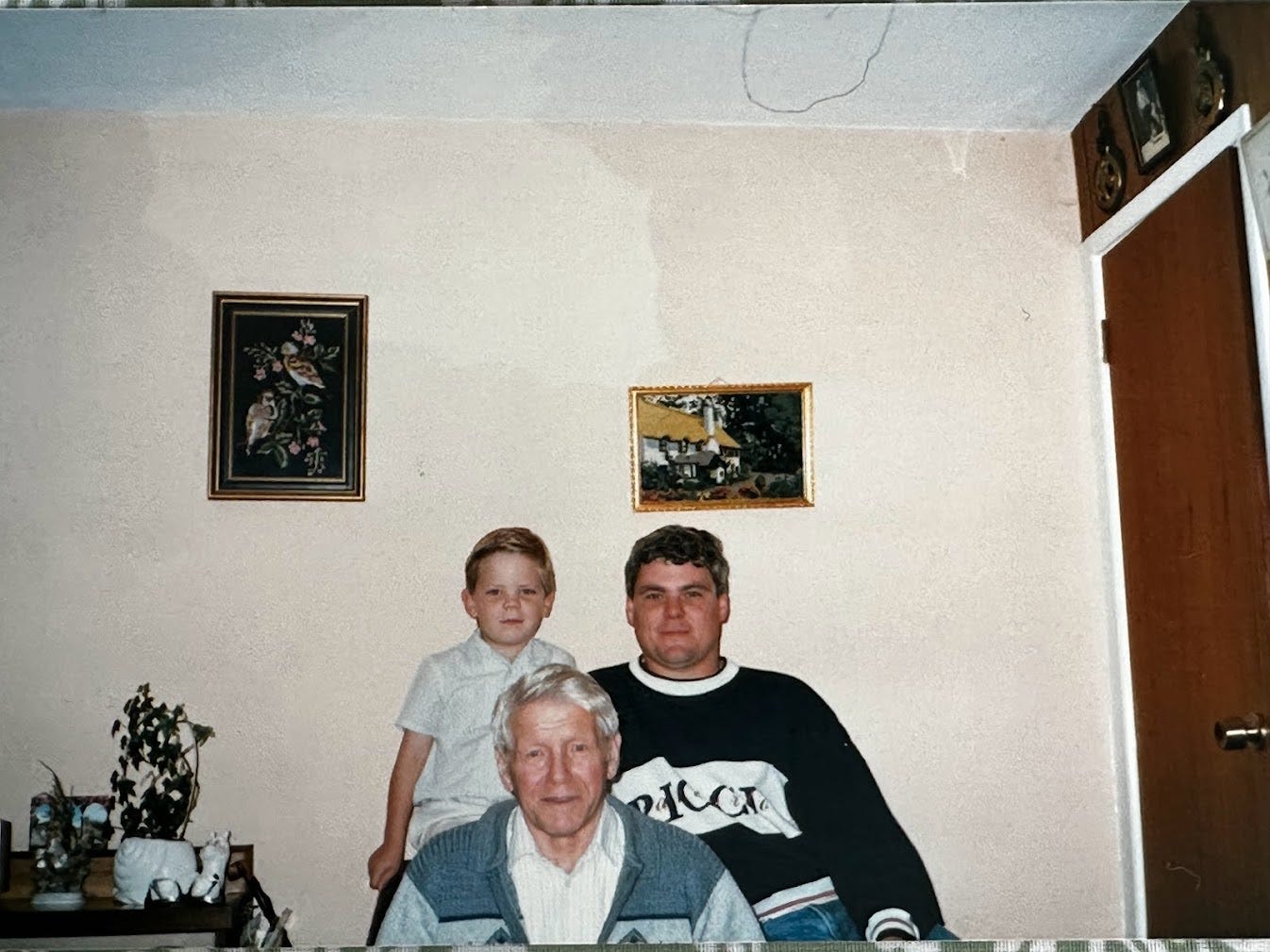
There’s a photograph I own, taken at the tail end of the 1980s, that is unlike all the others.
Within its frame are three people: myself, my father, and his father before him. Three generations of Maguire men huddled around a single seat in my grandparents’ living room in Ireland. The framing is terrible—we see more of the ceiling than of my grandfather, foreshadowing how my kids would feel when FaceTiming their grandparents decades later. Jack, my grandad, sits up straight, his face proud, wearing a cardigan that I look at enviously as an adult today. Over his left shoulder is my father, Kevin Senior, a few years shy of his thirtieth birthday. Over his right, a small boy, to whom the guard is being passed, who wears a crisp white shirt and looks towards the camera, blissfully ignorant.
In the five years I’ve been writing this newsletter, I’ve spent more time thinking about my place in the lineage of these men than I’d care to mention. I often think about what fatherhood meant for them, and the countless dads who came before. Fatherhood for those Maguire men may not have been easier, but it was undoubtedly simpler. Their role was set in stone. Variation from the norm was actively avoided, never encouraged.
While the number of children these men raised was different—I am one of three, my father one of fifteen—their versions of fatherhood were remarkably similar. They operated within a model of fatherhood defined not by emotional availability but by physical capability. A version of fatherhood reduced to responsibility. Culture cast those generations as stoic providers, parents who left early for work and returned home late, family disciplinarians with a swift backhand, or emotionally recluses with a stiff upper lip.
We inherited these narratives. We were shaped by them—for many of us, both metaphorically and physically. There is no way the father who came before you did not, in some way, define the one you are today. We were born into the water our fathers swam in, learned its currents, and are teaching our children to do the same. Looking at these three generations of men, I realise that whilst the seas I sail are uncharted, the tools I have to navigate them are better than anything they were given.
Three years ago, as I started to shop around a proposal for what would become the book that I would pour so much of myself into, multiple publishers turned me down, telling me the same thing: Dads don’t read books. It felt like such strange feedback. Of course, dads read books. I’m a dad, and I read all the time. I talk about books with my dad friends—not all of them, but enough. And I had a proof point beyond anecdotal: every week I send these missives out into the world, and more than 23,000 of you willingly receive them.
In the early days of the newsletter, we used to gather in discussion threads on a Friday. “What are you reading?” was always a hit. It was no surprise to learn that dads were reading all kinds of books. But when it came to fatherhood books, we’ve been woefully underserved. At best, the genre sees our role as a list of boxes to be checked off. At worst, it treats it like a joke, a side quest, or a distraction from the main story.
I was gifted one such book in 2014, as my first child was about to enter the world. Titled From Lad to Dad, it was, according to the front matter, written in 2004, but felt like it was cobbled together from cut-outs of UK 90s lad mags like Loaded and FHM, popular with teenage boys of the time. Opening to one page (and paraphrasing here, but only lightly), it offered the following advice to expectant dads: “Boobs! They’re great, right? We all love them. But maybe, for the next few months, don’t grab your missus’s boobs all the time, because they might be a bit more tender than usual.”
Over the next 12 years, with a few notable exceptions, it remained as such. I set out to buck the trend and write what I wish someone had given me at any point over the last decade-and-change. And now that my latest offspring has been in the world for a month, I’ve been hearing from dads who’ve read it. I spoke to them last month as I went out on tour: in New York, London, Manchester and Barcelona. In London, we gathered on a Thursday evening and during the Q&A one guy asked, “What advice do you have for a soon-to-be dad who wants to build up his support network with local dads?” I shared a few relevant pieces from the book: start reaching out to friends you know and putting the vulnerability loop into practice; think about building a Dadvisory Board; find a local dad meet-up, or even start your own.
“You’ve probably got time,” I suggested. “When does the baby arrive?”
“This Tuesday.”
As I was signing copies, I saw that dad-to-be sat with another two. Three local dads, none of whom I knew, swapping numbers, suggesting they start a local meet-up. I witness moments like this and see stark reminders of how essential this work is. Friends and strangers have been sending me messages with their favourite passages highlighted, or emailing to share their perspective on their place in the lineage of dads who have come before and will come after. Rikesh Chauhan, who moderated the London event, even made a video about it:
“Fatherhood is challenging when you’re walking down a path you’re simultaneously creating yourself.” I had 80,000 words, and couldn’t have said it better than Rikesh. What will this path look like for my son when he’s old enough to become a father? If he follows in my footsteps, he’ll welcome a child into the world sometime around 2050. The planet might be on fire, and in 25 years, Dad’s role might amount to the occasional trip outside the bunker, heading to the surface to scavenge for supplies. But I’d wager that whatever being a dad looks like for him, it’ll be closer to the dad he grew up with than my version was to the men at the top of this page.
A favour, from one dad to another
There’s a reason I sit here, week in, week out, writing to you all. It’s because I know, firsthand, how important it is that we learn to forge this barely-there path before us. How essential it is to our own well-being, and that of our kids, that they grow up with fathers they’re proud of. The work we do here is not easy, but its impact is intergenerational: what we stop from passing on today will be one less thing for our children to deal with tomorrow.
Fatherhood is changing, and it isn’t happening in a vacuum. One question I’ve been repeatedly asked as I’ve done press around the book is, “So, what does The New Fatherhood look like?” To answer it, I’ve often paraphrased US Supreme Court Justice Potter Stewart: “You know it when you see it.”
It’s the dad who leaves work at 3 pm to go pick up his kids, even as his male manager mutters under his breath, “Why isn’t his wife doing that?” It’s a group of guys who get together in the pub to learn how to braid their daughters’ hair. It’s a bunch of strangers turning up in the comments of a long-lost Aphex Twin video to share their deepest dreams and darkest fears on fatherhood. It’s the father who isn’t afraid to cry at a kid’s movie about a singing lion. And, again and again, it’s an Australian Cattle Dog who helps remind us that our presence, and not our ability to provide, will be what shapes our children’s futures.
This work has put me in the orbit of so many amazing dads, and it’s been a genuine pleasure to learn from you, as I hope you sometimes learn from me. I dedicated years of my life to writing this book because I saw the dads out there working to push fatherhood forward, and wanted to write the book that captured this once-in-an-epoch change. In a genre littered with manuals, I wrote a manifesto—a call to arms for a new kind of fatherhood. But I need your help to get the word out there.
This place has been, and will always be, driven by one thing: dads looking out for dads. And if you’ve got this far, congratulations: you passed the test. You’re proving them all wrong—you’re a dad who reads. And a book can become something a newsletter never can: in the history of humanity, there has been no more dependable way to pass on knowledge from one person to another.
So if this newsletter has helped or humoured you in any way over the last five years, please:
Buy the book. (Or if audiobooks are your thing, download it on Audible or Spotify.)
If you’ve bought it and enjoyed it, leave a review on Goodreads or Amazon. As of this evening, there are about three reviews from mums for every one from a dad. Your review will help redress the balance, and help other dads find it—and know that it’s worth their time.
If you’re more inclined to share privately than publicly, send this link to any dads that you think will get something out of it. There is absolutely no better way for this book to get to the dads who need it and will read it than one friend saying to another, “I’ve been reading this newsletter for a while, and think you will enjoy this book.” Tap to open a ready-made message: WhatsApp | Email
If you wanted to go a step further, why not buy it for a friend? You might buy books for mates regularly; it’s just as likely that you don’t. But take it from someone who lives in a city where it’s an annual tradition to do it: it’s one of life’s greatest delights to be handed a book by a buddy and for them to say, “I see you, I know you, I think you’ll dig this.” Think of a positive feeling this newsletter has given you over the years, and then imagine being able to give that to a friend. Pick a mate you know who loves books and is showing up as a dad in a way you admire, and go make his Father’s Day this year.
I’ve got a somewhat secondary motive here. It’s not just selling books. As the press has started to pick up around the launch, interest in the therapy fund has risen accordingly. So over the last month, on top of the interviews, the book tour, the newsletter and the onslaught of end-of-school-year calendar invites, I’ve been fielding an uptick in my inbox from dads looking to be paired with a therapist. The fund is running low, so for this week and next, I’m going to put all my book proceeds towards helping dads get therapy. And if you buy using one of the links below, the affiliate money from these sites will double your donation.
Amazon US | Bookshop US | Amazon UK | Bookshop UK | Amazon Rest of World
Thank you for reading this newsletter, and for doing your part to leave fatherhood in a better place than we found it.
— Kevin
Thanks for all your hard work Kevin, I just bought your book and I am excited to read it. I grew up in an Irish Catholic household with four kids, my dad was one of nine, I have two little ones now. At times I struggle to debug the old school dad software I was programmed with, I am grateful to find your work.
Hey Kevin, I was at your book launch the other night at Backstory. If all goes well I'll be a father in a few months... looking forward to following along here, and maybe having you on my podcast at some point.